In May 2010, a programmer in Jacksonville, Florida offered 10,000 bitcoin on an internet forum to anyone who would get him two pizzas, and on May 22 he reported that the trade had gone through. At the time, it read as a fun experiment, because bitcoin was a curiosity traded among a small circle of hobbyists on an internet forum. (The full story is in the Bitcoin History Timeline.)
Today a single bitcoin trades for far more than a pizza, and it is held by retirement accounts, public companies and ordinary people around the world. Yet nothing about the code that ran in 2010 promised any of that. No company backs it. No government guarantees it. There is no vault of gold behind it.
So the question every newcomer eventually asks is a fair one: why is this worth anything at all? The short answer is that Bitcoin gets its value the same way everything else does. The longer answer is more interesting.
Nothing Has Value on Its Own
Start with a principle economists have used since the 1870s: value is subjective. That means a thing is worth what people are willing to give up to get it, not what it is made of. Water is essential and cheap. Diamonds are mostly decorative and expensive. The difference is not usefulness, it is how much people want something compared with how much of it there is.
Every form of money passes this test in its own way. Gold is valued because it is rare, does not rust, and people have trusted it for thousands of years. The US dollar is valued because the government accepts it for taxes, federal law makes it legal tender for debts, and hundreds of millions of people use it every day. Neither is valuable "by nature." Both are valuable because of properties people care about, plus a shared expectation that others will keep accepting them.
Bitcoin plays by the same rules. The real question is not "what backs it?" but "what properties does it have that people want?"
Analogy: Think of a language. English is not valuable because of the letters themselves. It is valuable because so many people speak it that learning it opens doors. Every new speaker makes it a little more useful for everyone else. Money works the same way: the more people accept it, the more useful it becomes to hold.
The Properties People Pay For
Here is how the three forms of money compare on the question of what holds their value up.
| Gold | US dollar | Bitcoin | |
|---|---|---|---|
| What makes it scarce | Physics: it is hard to dig up | Policy: the Federal Reserve decides supply | Code: a hard cap of 21 million |
| Who can create more | Miners, slowly | The central bank and lending banks | Nobody beyond the fixed schedule |
| How you check it is real | Assay tests, trusted dealers | Trust in the issuer | Anyone can verify with free software |
| How it moves | Physically, slowly | Through banks and payment companies | Directly, anywhere, any hour |
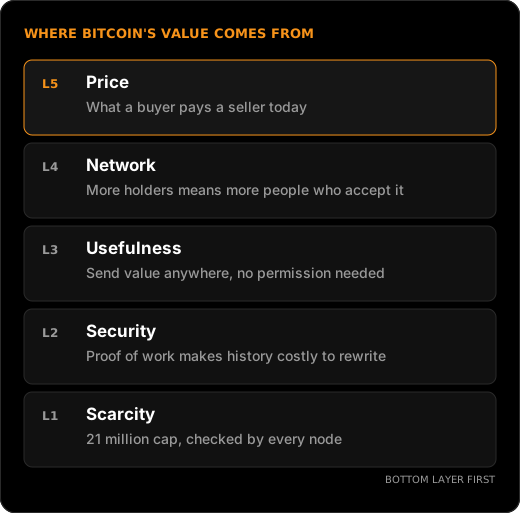
The column that makes Bitcoin unusual is the first one. In Bitcoin Core, the software most of the network runs, new coins can only enter circulation as a reward for adding a block, and that reward is cut in half every 210,000 blocks. Add up the whole schedule and the total can never pass 21 million coins, each divided into 100 million smaller units. Every computer running the software (called a node) checks every new transaction against these rules and rejects anything that breaks them. Nobody needs to trust a promise. They can check. The 21 million cap article explains how that limit is enforced in detail.
Why "It Costs Electricity" Is Not the Whole Answer
A popular explanation says Bitcoin has value because mining it costs real energy. There is something to this. Mining is the process where computers compete to add the next batch of transactions to the shared ledger, and they must spend electricity to win. The whitepaper itself compares the steady release of new coins to "gold miners expending resources to add gold to circulation."
But cost alone does not create value. If it did, anything expensive to make would be valuable, and plenty of expensive things are worthless. What the energy actually buys is security: rewriting Bitcoin's history would require out-spending all the honest miners combined, which the whitepaper describes as the core of the system's defense. Security is a property people value. The electricity is the price of providing it, not the source of the value itself.
The Network Gets Stronger as It Grows
Bitcoin's value also comes from its network, meaning the people and businesses that hold it, accept it and build on it. A form of money nobody accepts is useless, no matter how clever its design.
That network has grown in ways that are easy to verify. On January 10, 2024, the US Securities and Exchange Commission approved the listing of spot bitcoin exchange-traded products, which let people buy bitcoin exposure through an ordinary brokerage account. The SEC was careful to say it "did not approve or endorse bitcoin." That is exactly the point: a regulator does not need to endorse something for it to have value. It only needs enough people wanting it that ignoring them is no longer an option.
The Honest Objections
A fair answer has to include the strongest arguments against Bitcoin's value.
"It produces nothing." True. Bitcoin pays no dividends or interest. Neither does gold, or a dollar bill in your drawer. Things held as money are valued for storing and moving value, not for producing income.
"It only works because people believe in it." Also true, and also true of every currency on earth. The useful question is whether the belief rests on something checkable. With Bitcoin, the supply rules and the full history of every transaction are public.
"The price swings too much." This is the strongest objection. Bitcoin's price has fallen by more than half several times in its history. A thing can have value and still be extremely volatile, and anyone holding it needs to understand that the market can disagree with them for years.
What This Means for You
- Ask what properties, not what backing. Every form of money is valued for its properties. Judge Bitcoin by whether its properties matter to you.
- Verify instead of trusting. The supply cap and the ledger are public. Reading how they work is free, and it is the best defense against hype.
- Separate value from price. Value is why people want something. Price is what one buyer paid one seller a moment ago. Watch the live number on the converter without mistaking it for the whole story.
- Respect the volatility. Something can be valuable and still drop 50 percent. Understanding both at once is the beginning of understanding Bitcoin.
Bitcoin is worth something for the same reason anything is: enough people want it, and nobody can make more.