You buy $50 of bitcoin every week for three years. You never sell. Then one day you use a little of it to pay for a $40 gift card. Congratulations: you just created a taxable event, and you need to know what you paid for the exact coins you spent.
That surprises a lot of stackers, and it all traces back to one line. In Notice 2014-21, the IRS stated that "virtual currency is treated as property" for federal tax purposes. Not currency. Property, like a stock or a piece of land. Every rule below follows from that.
This article explains how the rules work, using IRS publications as the source. It is education, not tax advice. Tax situations vary, the rules are still changing, and a qualified tax professional is the right person to apply them to yours.
Property, Not Money: The Rule Behind the Rules
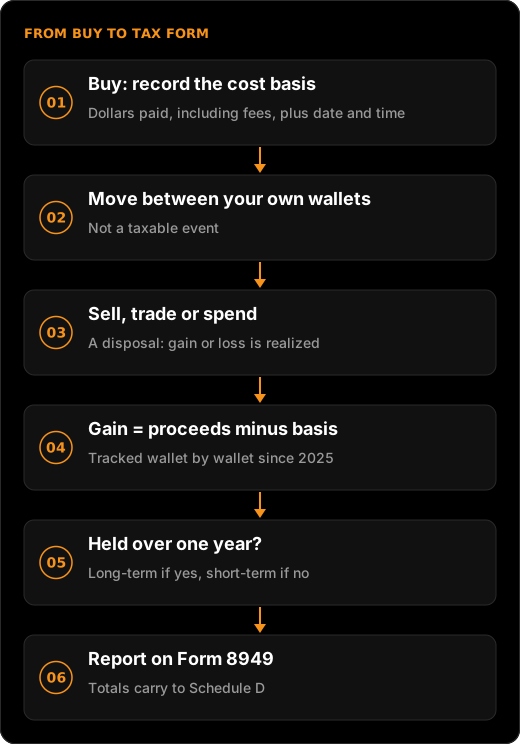
Because bitcoin is property, selling it, trading it for another asset, or spending it on goods or services is a disposal. Each disposal produces a capital gain or loss: what you received in dollars, minus your cost basis (what you paid, in dollars, including fees).
Just as important is what is not a disposal. According to the IRS digital assets page, buying bitcoin with dollars, simply holding it, and moving it between wallets or accounts you control are not taxable events, unless you pay a transfer fee in bitcoin, which is itself a tiny disposal.
| Action | Taxable? | What it creates |
|---|---|---|
| Buy bitcoin with dollars | No | A cost basis to record |
| Hold it | No | Nothing yet |
| Move it between your own wallets | No | Keep records showing it stayed yours |
| Sell it for dollars | Yes | Capital gain or loss |
| Spend it on goods or services | Yes | Capital gain or loss |
| Trade it for another crypto asset | Yes | Capital gain or loss |
| Receive it as wages or for services | Yes | Ordinary income at fair market value |
| Receive it from mining | Yes | Ordinary income at fair market value (Notice 2014-21) |
| Receive new coins from a hard-fork airdrop | Yes | Ordinary income (Rev. Rul. 2019-24) |
| Receive it as a gift | No, until you dispose of it | You generally take over the giver's basis |
Form 1040 and several other federal returns also ask a yes or no question about digital assets. Per the IRS, answering "No" fits someone who only bought with dollars, held, or moved coins between their own wallets that year.
Short Term, Long Term, and Why the Date Matters
The holding period decides the tax rate. Bitcoin held one year or less produces a short-term gain, taxed at ordinary income rates. Held more than one year, it is long-term.
For tax year 2025, IRS Topic 409 lists long-term rates of 0, 15 and 20 percent, with the 0 percent rate applying to taxable income up to $48,350 for single filers and $96,700 for married couples filing jointly. Those thresholds adjust each year. On the loss side, net capital losses can offset up to $3,000 of other income per year ($1,500 if married filing separately), with the rest carried forward.
Analogy: Think of every purchase as a separate jar with a date and a price written on the lid. When you spend some bitcoin, the IRS wants to know which jar it came from, because the lid decides both your gain and your rate.
Whether and when to realize gains is a strategy question covered in Taking Profits vs. Holding Forever. This article sticks to the rules. To see how a hypothetical gain is calculated from a purchase price and a current price, the ROI calculator does the arithmetic.
Which Coins Did You Sell? The Wallet-by-Wallet Rule
A weekly stacker owns dozens or hundreds of jars, so identification matters. Under final Treasury regulations that apply to acquisitions and dispositions on or after January 1, 2025, basis is tracked wallet by wallet (or account by account). You can no longer pool every coin you own across every platform into one universal list.
Within each wallet or account, you can specifically identify which units you are selling if your records support it. If you do not, the default is first in, first out (FIFO): the oldest units in that wallet or account are treated as sold first. For coins held at a broker, IRS Notice 2026-20 extends a temporary relief through calendar year 2026 that lets you record your identification or a standing order in your own books rather than communicating it to the broker. That relief does not cover coins in your own wallet, and it is scheduled to end after 2026.
This is why recordkeeping is not optional. The practical side is covered in How to Track Your Stack.
Form 1099-DA: The New Paper Trail
Brokers now report digital asset sales to the IRS on Form 1099-DA. Per the IRS:
- Gross proceeds are reported for transactions on or after January 1, 2025. Forms covering 2025 sales were issued in 2026.
- Cost basis is reported for certain transactions on or after January 1, 2026, but only for "covered securities." Under the form instructions, that generally means bitcoin acquired after 2025 in an account where the broker provided custody, and held there until sold.
The catch for stackers: coins bought before 2026, or transferred in from another wallet or platform, are generally noncovered. The broker may report your sale proceeds with no basis at all. Without your own records, a sale can look like 100 percent gain on paper.
Whatever the 1099-DA shows, capital transactions are reported on Form 8949, with the totals flowing to Schedule D.
The Wash Sale Question, as of October 2026
For stocks, the wash sale rule disallows a loss if you buy substantially identical stock within 30 days before or after the sale. The statute, Section 1091 of the Internal Revenue Code, is written for "stock or securities." Bitcoin held directly is treated as property under Notice 2014-21, and as of early October 2026 Section 1091 had not been amended to cover it. Shares of a bitcoin ETF, however, are securities, so the rule applies to them.
This is the most time-sensitive line in this article. On September 16, 2026, the House Ways and Means Committee voted 38 to 5 to report H.R. 10357, the Digital Asset Tax Certainty Act, as amended. The committee's amended text would rewrite Section 1091 to cover "traded digital assets" (other than qualified dollar stablecoins) and would apply to dispositions after September 14, 2026. A committee vote is not a law: the bill would still need to pass the full House and the Senate and be signed. Because the proposed start date reaches back before any final vote, the status of a loss sale made this fall is a question for a tax professional.
What This Means for You
- Every disposal is a tax event. Selling, spending and trading all count, including small purchases paid in bitcoin.
- Basis records start at the purchase. Date, time, dollars paid, fees and which wallet the coins live in.
- The 1099-DA may not tell the whole story. Coins bought before 2026 or transferred in often arrive with no basis reported.
- The calendar matters. Holding more than one year is what separates long-term from short-term treatment.
- Some rules are still moving. Wash sale status and broker relief are changing; a tax professional can confirm what applies to your year.
Buying is quiet. Every sale, swap and spend gets its own line on Form 8949.