On December 18, 2013, a user on the Bitcoin Forum posted a typo-filled rant titled "I AM HODLING." The author admitted to being a bad trader, knowing it, and simply choosing to hold. The misspelling became a rallying cry, then a philosophy, and eventually a word people use without knowing where it came from.
Over a decade later, the question that post was really about has not gone away. When your bitcoin has gone up a lot, do you sell some? When it has gone down a lot, do you hold through it? And how do you decide before emotion decides for you?
There is no universally right answer. But there are clear strategies, real trade-offs, and one factor most people underestimate until April: taxes.
The Case for Holding Forever
The holding philosophy rests on a few arguments that are worth stating fairly.
First, conviction about supply. Bitcoin's issuance is fixed in code, capped just under 21 million coins. Holders who believe demand will keep growing see any sale as trading a scarce asset for an inflating one.
Second, the cost of being wrong in the other direction. Bitcoin's history includes long stretches where selling early meant missing most of the gain. The people who sold at the first doubling are a recurring cautionary tale in Bitcoin circles.
Third, taxes. In the US, the IRS treats bitcoin as property, and a gain is taxed when you sell, exchange or otherwise dispose of it, not while you hold. Holding defers the bill indefinitely.
Fourth, and least discussed: holding is the strategy that asks the least of your judgment. The original HODL post was, at heart, an admission that trading well is hard.
The Case for Taking Something Off the Table
The other side has arguments that are just as real.
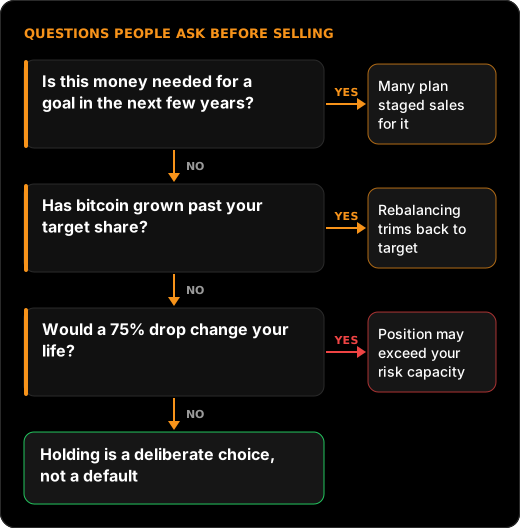
Concentration risk is the big one. The BlackRock Investment Institute noted in December 2024 that bitcoin has seen selloffs of 70 to 80 percent from peak to bottom during its history. A position that grew from 5 percent to 40 percent of someone's net worth during a rally is a very different risk than the one they originally chose, even though they never bought another sat.
Then there are actual goals. A down payment, tuition, or a business needs dollars on a specific date. Money with a deadline cannot wait out a multi-year drawdown, and the buying-the-dip logic that helps on the way in does not help when you need to sell on schedule.
Analogy: Think of a farmer with an orchard. Holding forever is never harvesting because next year's crop might be bigger. Selling everything is cutting down the trees. Most farmers do neither: they harvest some fruit every season and let the trees keep growing.
Four Ways People Take Profits
People who do sell tend to use one of a handful of rule-based approaches. The rule matters more than the method, because it is set before the price moves.
| Approach | How it works | Main trade-off |
|---|---|---|
| Rebalancing | Pick a target share; trim back to it on a schedule or when it drifts past a set band | Sells into strength, which can mean selling early in a long rally |
| Staged sales | Sell a fixed slice at preset price levels or dates | Removes in-the-moment judgment, but the levels are guesses |
| Goal funding | Sell only what a specific, dated goal requires | Clear purpose, but the timing is set by life, not the market |
| Recover the cost basis | Sell enough to get the original dollars back, hold the rest | Psychologically freeing, but the sale is still mostly taxable gain |
The SEC's guide to rebalancing describes the two common triggers: rebalancing on a regular calendar, such as every six or twelve months, or only when an asset's weight moves more than a set percentage away from its target. It also notes a gentler option that avoids selling entirely: steering new contributions toward the parts of a portfolio that have fallen behind.
That last row deserves a closer look. Suppose, hypothetically, $10,000 bought bitcoin now worth $40,000, and the holder sells $10,000 "to take out the original money." If it was one purchase, the coins sold are a quarter of the holding and carry a quarter of the cost basis, about $2,500. Roughly $7,500 of the sale is taxable gain. Getting your money back is not the same as getting it back tax-free.
The Tax Bill Changes the Math
For US taxpayers, timing a sale matters almost as much as deciding to make one. The IRS rule is simple: bitcoin held for more than one year before selling produces a long-term capital gain; held one year or less, a short-term gain.
Short-term gains are taxed at ordinary income rates. Long-term gains get their own lower rates. For tax year 2025, IRS Topic 409 lists 0, 15 or 20 percent depending on taxable income, and notes that the rate on most net capital gain is no higher than 15 percent for most individuals. Selling just before versus just after the one-year mark can change the bill noticeably, and every sale must be reported whether it produced a gain or a loss.
This is general information, not tax advice; the details, including lot selection and state taxes, are in Tax Basics for US Bitcoin Stackers. Before any sale, the ROI calculator helps you see the gain you are actually sitting on.
What This Means for You
- Write the rule before the rally. A selling plan made at calm prices is far more likely to be followed than one improvised at a peak.
- Watch your share, not just the price. Revisit what portion of your net worth bitcoin has become; How Much Bitcoin Should You Own? covers the frameworks.
- Match dated goals with dated plans. Money needed on a specific date is the strongest reason people give for selling in stages.
- Check the calendar before you click sell. Crossing the one-year mark changes how a US gain is taxed.
- Make holding a choice too. HODL works best as a decision you revisit, not a habit you never question.
The worst plan is the one you invent at the top.