You send a payment. The wallet says "sent." The recipient's wallet says "pending." Ten minutes pass, then thirty, and nothing changes. Where exactly is your money right now?
It is in the mempool, short for memory pool: the set of valid transactions a node has heard about that are not yet in a block. Your coins have not left, and they have not arrived. They are waiting for a miner to pick them.
The surprising part is that there is no such thing as the mempool. Every node keeps its own, built from what it has heard and filtered by its own settings. When people talk about "the mempool being full," they mean that most nodes' copies look roughly alike.
A Waiting Room With a Bouncer
Before a node adds your transaction to its mempool, it checks it. The first checks are consensus rules that every node enforces: the signatures must be valid and every input must point to an output that exists and has not been spent (the full logic is in How Transactions Work). Then come policy rules, which are each node's local choices about what to relay, such as minimum fees and size limits.
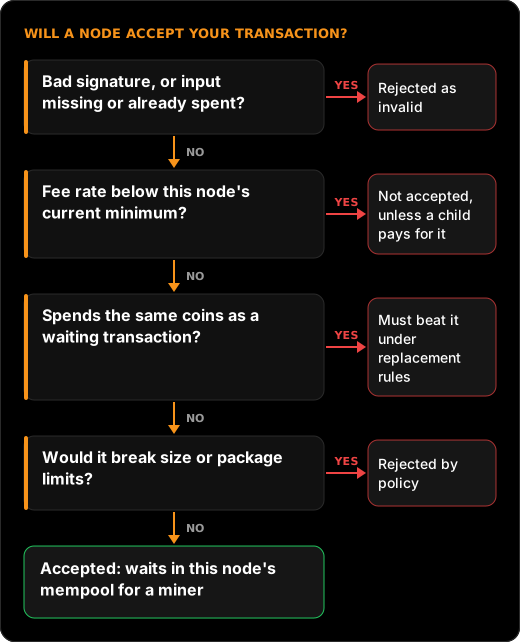
Once accepted, the node passes the transaction to its peers, and within seconds it is sitting in thousands of mempools around the world. Miners pull from their own mempool when they build a candidate block.
Fee Rate, Not Fee, Decides the Line
Blocks have a size budget. Since SegWit (BIP-141), a block is limited to 4 million weight units, which equals 1 million virtual bytes, or vB. Miners want the most fees they can fit into that budget, so they rank transactions by fee per unit of space: satoshis per virtual byte (sat/vB).
That means a big fee does not guarantee a fast confirmation. What matters is the fee divided by the size.
| Transaction | Size | Fee | Fee rate |
|---|---|---|---|
| Simple payment, 1 input, 2 outputs | about 141 vB | 705 sats | 5 sat/vB |
| Wallet spending 20 small coins | about 1,430 vB | 2,860 sats | 2 sat/vB |
| Same simple payment, in a hurry | about 141 vB | 2,820 sats | 20 sat/vB |
The second transaction pays four times the fee of the first but waits longer, because it takes ten times the space. The amount of bitcoin being sent does not appear anywhere in the calculation. Converting those sats into dollars is quick with the BTC and sats converter.
Analogy: Think of an airport standby list where seats go to whoever bids the most per kilogram of luggage. A huge bid with a mountain of suitcases can lose to a modest bid with a carry-on.
Not a Bottomless Pit
Mempools live in a node's memory, so they need limits. Bitcoin Core, the most widely used node software, ships with these defaults.
| Setting | Bitcoin Core default | Effect |
|---|---|---|
| Maximum mempool size | 300 MB of memory | When full, the lowest fee rate transactions are evicted |
| Expiry | 336 hours (14 days) | Unconfirmed transactions older than this are dropped |
| Minimum relay fee rate | 0.1 sat/vB (since version 29.1, September 2025) | Below this, the node will not relay a transaction |
| Cluster limit | 64 transactions or 101 kvB (since version 31.0) | Caps how large a group of linked unconfirmed transactions can grow |
When demand spikes and the 300 MB fills, the node evicts transactions from the bottom of the fee ranking and raises its own minimum fee to match. A low-fee transaction can therefore vanish from many mempools without ever being rejected for a flaw. Evicted is not lost: the coins never moved, the wallet can rebroadcast, and once the backlog clears the transaction may be accepted again.
Since Bitcoin Core 31.0, published on April 19, 2026, the mempool is organized into "clusters" of related transactions. Eviction, block building and replacement decisions all rank groups of linked transactions by the fee rate they would actually be mined at, rather than looking at each transaction alone.
Stuck? Two Ways to Push
Replace-by-Fee (RBF)
RBF lets you broadcast a new version of your transaction that spends the same coins with a higher fee. BIP-125 originally made this opt-in: the transaction had to signal it was replaceable. Bitcoin Core 28.0, released in October 2024, switched the default so nodes accept replacements whether or not the original signaled. The replacement must pay a higher total fee than what it displaces, plus enough extra to cover its own relay. Since 31.0, it must also leave the mempool strictly better off in fee terms.
RBF is why a zero-confirmation payment is not final. Until a transaction is in a block, the sender can replace it, including with one that pays someone else.
Child Pays for Parent (CPFP)
CPFP works from the other side. If you are receiving a stuck payment, or you have a change output from your own stuck transaction, you spend that unconfirmed output in a new "child" transaction with a generous fee. A miner can only collect the child's fee by also including the parent, so they evaluate the two together.
For example, a 200 vB parent paying 1 sat/vB (200 sats) plus a 150 vB child paying 3,300 sats forms a 350 vB package paying 3,500 sats: an effective 10 sat/vB. Since Bitcoin Core 28.0, nodes can also relay a single parent and child together, so a parent below a node's minimum fee can still get in with its child's help.
What Miners See
Miners are not obliged to follow any of this, but their incentive is simple: fill each block with the highest-paying transactions available. When the mempool is nearly empty, almost anything above the minimum gets into the next block. During a rush, fee rates climb until demand thins out. That recurring auction is the fee market, a revenue source designed to matter more as the subsidy halves, a story told in How Bitcoin Mining Actually Works. How the chosen transactions are packed is covered in What's Inside a Bitcoin Block.
What This Means for You
- Check the fee rate, not the fee. A sat/vB figure is the number that decides how soon a transaction confirms.
- Pending is not received. Until a transaction is in a block, it can be replaced, so large payments are usually treated as settled only after confirmations.
- Use a wallet that supports RBF or CPFP. Being able to bump a fee turns a stuck transaction into a minor delay.
- Time non-urgent moves. Consolidating coins or moving to cold storage costs less when mempools are quiet.
Your transaction is not lost in the mempool. It is simply standing in line, and the fee rate is your place in it.