Ask ten people what Bitcoin miners do and most will say they "solve complex math problems." It sounds right. It is also wrong in a way that hides the most elegant part of the design.
There is no equation. No clever insight finds a block faster. Mining is closer to rolling dice: a machine takes a small bundle of data, scrambles it through a hash function, checks whether the result is a small enough number, and if not, changes one field and tries again. In early October 2026 the whole network was doing this roughly 1,000 quintillion times per second.
That brute force is the point. A block is valuable precisely because it was expensive to find and costs almost nothing to check.
The Myth of the Math Puzzle
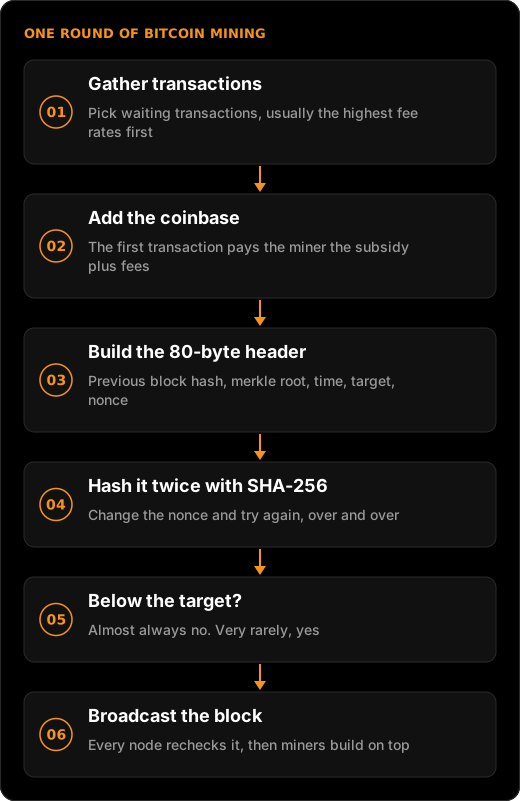
Here is the actual task. Every block has an 80-byte summary called the block header. Miners run that header through SHA-256 twice and read the output as a giant number. If the number is at or below a value called the target, the block is valid. If not, they change the header slightly and hash again.
SHA-256 has no shortcut. A one-bit change to the input produces an output that looks completely unrelated, so there is no way to steer toward a winning hash. The only strategy is more guesses per second. The whitepaper sums up the security model in one short sentence: "Proof-of-work is essentially one-CPU-one-vote." Today the CPU has been replaced by purpose-built chips called ASICs, but the vote is still counted in hashes.
Analogy: Picture a lottery where anyone can print their own tickets, as fast as their printer allows, and the winning ticket is any one whose serial number starts with a long run of zeros. Nobody can predict which ticket wins. The person with the fastest printer simply wins more often, and printing tickets costs electricity.
Building a Candidate Block
Before a miner can start guessing, it needs something to guess on. Each attempt starts with assembling a candidate block:
- Choose transactions. Unconfirmed transactions wait in each node's mempool. Miners usually pick the ones paying the highest fee per unit of block space, because block space is limited and fees are income.
- Write the coinbase transaction. The first transaction in every block has no sender. It creates new bitcoin and pays the miner the block subsidy (3.125 BTC since April 2024, per the halving schedule) plus every fee in the block.
- Fingerprint the transactions. All transaction IDs are hashed together into one 32-byte value called the merkle root. Change any transaction and the root changes.
- Fill in the header. Version, the previous block's hash, the merkle root, a timestamp, the encoded target, and a 32-bit number called the nonce.
The full anatomy of that header, field by field, is in What's Inside a Bitcoin Block.
The Guessing Loop
The nonce exists purely to be changed. It is 32 bits, so it can hold about 4.29 billion values. That sounds like plenty until you meet modern hardware, which can exhaust every nonce in a small fraction of a second.
When the nonce runs out, miners change something else. The developer documentation lists the standard options: update the timestamp, or alter the coinbase transaction (miners add a field often called the extra nonce), which changes the merkle root and gives a fresh 4.29 billion nonces to try. BIP320 also sets aside 16 bits of the version field that miners use the same way.
How many guesses does a block take? On average, about the current difficulty multiplied by 2 to the 32nd power. On October 7, 2026, mempool.space reported a difficulty of about 132.7 trillion, which works out to roughly 570 sextillion hashes per block. Spread across a network running near 1,000 exahashes per second, that is about 10 minutes of work. Not by coincidence.
Bitcoin Mining by the Numbers
| Item | Value | Where it comes from |
|---|---|---|
| Target time between blocks | 10 minutes | Protocol parameter |
| Block header size | 80 bytes | Protocol format |
| Nonce range | 2^32, about 4.29 billion | 32-bit header field |
| Block subsidy | 3.125 BTC | Halving schedule, since block 840,000 |
| Wait before mined coins can be spent | 100 blocks | Bitcoin Core COINBASE_MATURITY |
| Network difficulty | About 132.7 trillion | mempool.space, October 7, 2026 |
| Network hashrate | Roughly 1,000 EH/s | mempool.space estimate, early October 2026 |
The last two rows move constantly. The first five are written into the protocol.
Winning, Getting Paid, and Waiting
When a hash finally lands under the target, the miner broadcasts the block. Every node that receives it rechecks everything: the hash, the transactions, the signatures, and the coinbase amount. If the miner paid itself even one satoshi more than subsidy plus fees, the block is rejected and all that electricity was wasted. Checking takes one hash and some bookkeeping; finding took sextillions. That asymmetry is what makes proof of work useful.
Sometimes two miners find valid blocks at nearly the same moment. For a short while the network splits, with some nodes building on each. Whichever branch gets the next block first wins, because nodes follow the chain with the most accumulated work. The losing block is called stale, and its reward evaporates. This is one reason the coinbase reward cannot be spent for 100 blocks: if a block gets orphaned, its newly created coins must never have been spendable.
Why Miners Pool Their Luck
A single machine might go years without finding a block on its own. Its expected income is steady; its actual income is a lottery. Mining pools solve this. Thousands of participants hash on the same block template and get paid in proportion to their work, smoothing income into something closer to a paycheck.
The trade-off is concentration. In the 30 days to October 7, 2026, mempool.space attributed 25.6 percent of blocks to Foundry USA, 20.2 percent to AntPool and 15.5 percent to F2Pool. A pool operator chooses which transactions go into its template, which is real power. What it cannot do is change the rules: a pool that tried to create extra bitcoin would see its blocks rejected by every node. That separation is the subject of Nodes vs. Miners.
As more hashpower joins, blocks would come faster than every 10 minutes. They do not, because the difficulty adjustment moves the target every 2,016 blocks to keep the pace steady.
What This Means for You
- Mining secures, it does not invent value. Miners order transactions and make rewriting history expensive. The rules about supply are enforced by everyone else.
- Confirmations are measured in work. Each block on top of your transaction adds another 10 minutes of the whole network's hashing that an attacker would have to redo.
- Home mining is mostly a hobby now. With network hashrate near 1,000 EH/s, a single small machine is a lottery ticket, which is why nearly all hashpower sits in pools.
- Fees matter more each cycle. As the subsidy halves, transaction fees become a larger share of what miners earn, and your fee choice decides how quickly you get into a block.
- Think in satoshis. Block rewards and fees are counted in satoshis on chain; the BTC to sats converter makes those numbers easier to read.
Nobody solves Bitcoin. They just guess, faster than anyone else, and the guessing is the security.