Picture a finance ministry meeting where the question on the table is not "should we buy bonds?" but "what do we do with the bitcoin?" That meeting has now happened in at least three capitals, and each one reached a different answer.
El Salvador passed a law in 2021 that made bitcoin legal tender, then rewrote that law in 2025 to win a loan from the International Monetary Fund. Bhutan, a Himalayan kingdom, backed bitcoin mining on its zero-emissions power through its state investment company. The United States, which holds bitcoin mostly because it seized it from criminals, decided in 2025 to stop selling it.
None of these stories is as simple as the headlines made them sound. This article sticks to what the official documents say, with dates, because national policy on bitcoin changes fast. Everything here is current as of October 7, 2026.
El Salvador: The Law, Then the Rewrite
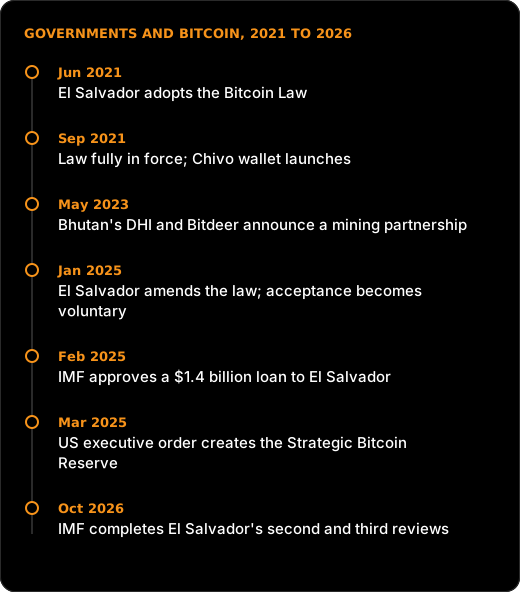
According to the IMF's 2021 Article IV report, El Salvador's Bitcoin Law was adopted on June 8, 2021. It required businesses to accept bitcoin for goods and services, guaranteed automatic conversion to US dollars through a state trust fund, and was fully implemented on September 7, 2021, alongside the government's Chivo e-wallet. Citizens who signed up received an initial allowance equivalent to US$30 in bitcoin. (The wider context sits in the Bitcoin History Timeline.)
The IMF objected from the start. Its 2022 report urged the government to narrow the law by removing bitcoin's legal tender status. For three years, the government declined.
The turn came with money: a 40-month, roughly US$1.4 billion Extended Fund Facility from the IMF, approved on February 26, 2025. One condition, a "prior action," was amending the Bitcoin Law. IMF Country Report 25/58 records that the amendments were published in El Salvador's Official Gazette on January 30, 2025. They made private acceptance of bitcoin voluntary, removed the characterization of bitcoin as a currency, repealed the authorization to pay taxes in bitcoin, and ended the state's obligation to guarantee bitcoin to dollar convertibility.
What El Salvador Still Holds
Amending the law did not mean selling the coins. El Salvador's National Bitcoin Office runs a public tracker at bitcoin.gob.sv that lists government addresses. Summing the balances that tracker reports gives about 7,797 BTC across 20 addresses as of October 7, 2026.
That number keeps edging up, and the IMF has noticed. In its October 1, 2026 press release completing the second and third program reviews (which released about US$138 million), the Fund said waivers "were granted for certain unmet performance criteria on Bitcoin accumulation" and that "No further Bitcoin accumulation is envisaged beyond the documented donations". The same release says the transfer of majority ownership and control of Chivo to a private operator has been completed.
Analogy: Think of a household that promises its bank, as a condition of a loan, to stop buying collectibles. The bank does not make it sell the collection it already owns. It just watches the shelf to see whether new pieces keep appearing.
Bhutan: Mining With River Power
Bhutan took a quieter route. It did not pass a bitcoin law or ask citizens to use it. Instead, it worked through Druk Holding & Investments (DHI), which a May 3, 2023 press release from the Nasdaq-listed miner Bitdeer describes as "the commercial arm of the Royal Government of Bhutan."
That press release announced a partnership to develop carbon-free digital asset mining operations in Bhutan using what it called "Bhutan's zero-emissions power," with a planned closed-end fund of up to US$500 million in which Bitdeer would be general partner and DHI a strategic limited partner. DHI's own website lists digital assets as one of its investment verticals.
Here is the honest gap: Bhutan has not published an address-level holdings tracker like El Salvador's, and DHI does not publish audited bitcoin balances on its site. The holdings figures quoted in the press come from blockchain analytics firms, not from the government. Until an official figure exists, the durable fact is the model itself: a state-owned company backing bitcoin mining powered by zero-emissions electricity.
The United States: A Reserve Built From Seizures
The US approach began with a stockpile it never meant to build. Federal agencies have forfeited bitcoin in criminal and civil cases for years, and those coins ended up spread across several departments.
Executive Order 14233, signed March 6, 2025, changed that. It directs the Treasury to establish a "Strategic Bitcoin Reserve" capitalized with bitcoin the Treasury holds that was "finally forfeited" in asset forfeiture proceedings, and states that bitcoin deposited into the reserve "shall not be sold." It directs the Treasury and Commerce secretaries to develop strategies for acquiring more, "provided that such strategies are budget neutral and do not impose incremental costs on United States taxpayers." It also set up a separate Digital Asset Stockpile for other forfeited tokens, and gave agencies 30 days to provide a full accounting of their digital asset holdings.
What the order did not do is buy anything with new money, or publish a reserve balance. A bill that would go further, the BITCOIN Act of 2025 (S.954 in the Senate and H.R.2032 in the House), proposes a federal purchase program. According to Congress.gov, as of October 7, 2026 both versions remain where they were on March 11, 2025: referred to committee, with no vote. The broader legislative picture is in US Bitcoin Regulation.
Three Models Side by Side
| El Salvador | Bhutan | United States | |
|---|---|---|---|
| How bitcoin was acquired | Purchases and donations | Mining, via the state-owned DHI and its Bitdeer partnership | Criminal and civil forfeiture |
| Legal status of bitcoin | Voluntary acceptance since the January 2025 amendment | No legal tender law | Commodity; held by the Treasury |
| Public disclosure | Address tracker at bitcoin.gob.sv | No official holdings tracker | No published reserve balance |
| Key outside pressure | IMF program conditions | None documented | Congress (BITCOIN Act pending) |
| Status as of Oct 7, 2026 | About 7,797 BTC on tracker | Not officially disclosed | Order in force; bill in committee |
The Debate Nobody Has Settled
Supporters argue that a fixed-supply asset belongs in national reserves alongside gold, and that a government holding bitcoin it already owns costs taxpayers nothing. Critics, including IMF staff in their reports on El Salvador, argue that a volatile asset creates fiscal and financial stability risks, and that scarce public money should not go to speculative investments.
Both sides are arguing about different designs. Mandatory legal tender (El Salvador 2021), state mining (Bhutan) and a no-sell rule for seized coins (the US) carry very different risks. Lumping them together as "nations adopting bitcoin" hides most of what matters. And for any government, the practical question of who controls the keys is the same one institutions face, covered in How Institutions Custody Billions in Bitcoin.
What This Means for You
- Read the decree, not the headline. El Salvador's "legal tender" status was narrowed in January 2025. Many articles still describe the 2021 version.
- Holding is not the same as buying. The US reserve is built from forfeited coins, and new purchases must be budget neutral under the order.
- Check the disclosure model. Only El Salvador publishes addresses. Treat any figure for other governments as an estimate unless an official source confirms it.
- Watch Congress.gov, not social media. The BITCOIN Act's status is public and updated there. As of this writing it sits in committee.
- Translate the numbers yourself. To see what 7,797 BTC means at today's price, try the BTC converter.
Governments are now bitcoin holders, but each one wrote a very different rulebook.