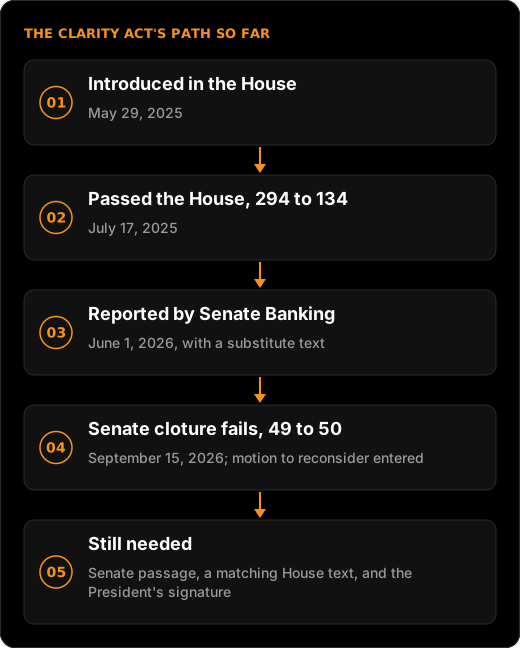
On September 15, 2026, the US Senate voted 49 to 50 on whether to even begin debating the main crypto market structure bill. Cloture needs 60 votes, three-fifths of the Senate, so the motion fell 11 votes short. The bill did not die, but it did not move either.
That vote captures US bitcoin regulation better than any summary could. A lot has changed since January 2025: two crypto measures signed into law, new guidance from the main federal agencies, and a formal statement from the SEC that bitcoin is not a security. But the comprehensive framework that both parties have talked about for years is still not law.
If you have ever wondered who is actually in charge of bitcoin in the United States, the answer is: several agencies at once, each holding a different piece. Here is the map, dated October 7, 2026, and built only from government documents.
Four Agencies, Four Different Jobs
Bitcoin does not have one regulator in the US. It has a patchwork, and each agency reached its role through a different door.
| Agency | Its piece of bitcoin | Key primary document |
|---|---|---|
| CFTC | Treats bitcoin as a commodity; oversees futures and polices fraud in spot markets | 2015 Coinflip order |
| SEC | Securities laws; approves exchange-traded products; custody rules for investment advisers | Release 33-11412 (March 17, 2026) |
| Treasury and FinCEN | Anti-money-laundering rules for exchanges and other money transmitters | FIN-2019-G001 (May 9, 2019) |
| IRS | Taxes bitcoin as property; broker reporting on Form 1099-DA | Notice 2014-21; 1099-DA final rules |
Analogy: Think of a car. The highway patrol cares how you drive it, the DMV cares who owns it, the tax office cares what you paid for it, and the dealer's regulator cares how it was sold. Nobody is "the car regulator." Bitcoin works the same way in the US.
The CFTC: Bitcoin Is a Commodity
The Commodity Futures Trading Commission got there first. In a September 17, 2015 order against a platform called Coinflip, the agency found, in the words of its press release, that "Bitcoin and other virtual currencies are properly defined as commodities." That gave the CFTC authority over bitcoin futures and the power to pursue fraud and manipulation in the underlying market, though not full day-to-day oversight of spot exchanges.
The SEC: From Gatekeeper to Formal Clarity
For years the Securities and Exchange Commission's relevance to bitcoin came through products built on it, most visibly the spot bitcoin ETFs it approved in January 2024 (covered in Bitcoin ETFs Explained).
The bigger shift came on March 17, 2026. In Release No. 33-11412, issued together with related guidance from the CFTC, the SEC set out a taxonomy of crypto assets: digital commodities, digital collectibles, digital tools, stablecoins and digital securities. It lists Bitcoin (BTC) among its examples of digital commodities, and states that a digital commodity "is not a security because it does not have the economic characteristics of a security." The release is an interpretation, not a statute, so a future Commission or a court could see it differently.
The SEC also shapes how professionals hold bitcoin. On October 1, 2026 it proposed new custody rules for investment advisers and funds holding crypto assets, which is the subject of How Institutions Custody Billions in Bitcoin.
Treasury, FinCEN and the IRS: Money Laundering and Taxes
FinCEN, a bureau of the Treasury, treats businesses that exchange or transmit bitcoin for customers as money transmitters under the Bank Secrecy Act. Its May 9, 2019 guidance (FIN-2019-G001) explains how that applies across business models, from exchanges to kiosks. That is why a US platform asks for identification before you buy: if you are comparing platforms, the exchange comparison shows which ones operate under these rules.
The IRS position has been stable since 2014. Notice 2014-21 says: "For federal tax purposes, virtual currency is treated as property." What changed recently is reporting. Under final regulations issued in 2024, brokers must report gross proceeds on Form 1099-DA for sales on or after January 1, 2025, and basis for certain sales on or after January 1, 2026. A separate rule that would have extended broker reporting to some decentralized finance platforms was overturned by Congress through H.J.Res.25, signed April 10, 2025 as Public Law 119-5. The individual angle is in Tax Basics for US Bitcoin Stackers.
What Congress Has Actually Passed
Separating enacted law from proposals is the single most useful habit here. As of October 7, 2026, according to Congress.gov:
| Measure | What it does | Status |
|---|---|---|
| GENIUS Act (S.1582) | Federal framework for payment stablecoins | Law: Public Law 119-27, July 18, 2025 |
| H.J.Res.25 | Repealed the IRS DeFi broker reporting rule | Law: Public Law 119-5, April 10, 2025 |
| CLARITY Act (H.R.3633) | Market structure: splits oversight between the SEC and CFTC | Passed House; Senate cloture failed September 15, 2026 |
| Anti-CBDC Surveillance State Act (H.R.1919) | Bars a Federal Reserve retail digital currency | Passed House July 17, 2025; no Senate action |
| BITCOIN Act (S.954 and H.R.2032) | Federal bitcoin purchase program | In committee since March 11, 2025 |
Neither enacted law is about bitcoin directly. The GENIUS Act covers dollar stablecoins; H.J.Res.25 is about tax reporting. The bill that would most directly reshape bitcoin markets is CLARITY, which would give the CFTC a defined role over spot markets for digital commodities.
The Executive Branch Moved Faster
While Congress debated, the White House acted by order. Executive Order 14178, signed January 23, 2025, set a policy of supporting digital assets and prohibited agencies from promoting a US central bank digital currency. Executive Order 14233, signed March 6, 2025, created the Strategic Bitcoin Reserve from forfeited coins, explained in Nations Adopting Bitcoin.
The limitation is obvious: executive orders and agency interpretations can be reversed by the next administration. Statutes are much harder to undo. That is why supporters of CLARITY argue it matters even after the SEC's 2026 release, and why critics, who argue the bill weakens investor protections, have fought it so hard. Both positions are on the record in the Senate's 49 to 50 vote.
What This Means for You
- Know which rule is law. In the table above, only the GENIUS Act and H.J.Res.25 are enacted. Everything else is still a bill.
- Bitcoin's classification is clearer than ever. The CFTC called it a commodity in 2015, and the SEC's 2026 release lists it as a digital commodity, not a security.
- Expect tax paperwork. Brokers now send Form 1099-DA, with basis reporting for sales from 2026 onward.
- Treat orders as reversible. Executive orders and staff guidance can change with leadership. Statutes are the durable layer.
- Check the date on anything you read. Use the Congress.gov "all actions" page for the current status of any bill.
In Washington, a bill that has passed only one chamber is still just a bill.