In the 30 days to October 7, 2026, three mining pools found more than 60 percent of all Bitcoin blocks: Foundry USA with 25.6 percent, AntPool with 20.2 percent and F2Pool with 15.5 percent, according to mempool.space. If you heard that number about any other system, you would assume those three run it.
They do not. If those three pools agreed tomorrow to pay themselves an extra 1,000 BTC each, their blocks would be rejected within seconds, by laptops, by small servers in closets, by exchanges and by hobbyists. All the electricity spent finding those blocks would be wasted on blocks that nobody accepts.
That gap between who builds Bitcoin and who decides what counts as Bitcoin is the most misunderstood power structure in the system.
Two Jobs, Often Confused
Every Bitcoin user relies on two kinds of participants, and they do very different work.
Miners gather transactions, assemble them into blocks, and spend electricity searching for a valid proof of work, as described in How Bitcoin Mining Actually Works. Their power is over ordering: which transactions go in the next block, and in what sequence.
Full nodes download every block and check every rule from scratch. Signatures, spending history, block size, the subsidy amount, the proof of work itself. A node that receives an invalid block does not argue; it simply discards it and keeps following the valid chain.
| Miners | Full nodes | |
|---|---|---|
| Main job | Propose new blocks | Verify every block and transaction |
| Cost to participate | Specialized hardware and cheap power | An ordinary computer; Bitcoin Core can prune old blocks down to 550 MiB of block storage |
| Can choose which transactions go in a block | Yes | No |
| Can create extra bitcoin | No | No, and they reject anyone who tries |
| Can change the rules alone | No | Only for themselves |
The overview in How Bitcoin Works introduces this split. Here is how it plays out under pressure.
Analogy: Think of a newspaper with thousands of independent editors. Reporters compete to file the next page, and the winner gets paid when it runs. But every editor checks each page against the same style guide, and a page that breaks the guide never runs, no matter how hard the reporter worked. Reporters decide what gets written. Editors decide what gets printed.
What Miners Actually Control
Hashpower is real power, just narrower than it sounds. A miner or pool can leave transactions out of its blocks. Pools choose the block template, so a large pool can delay a transaction it does not want to include, though any other miner can pick it up.
A miner with a majority of the hashpower could do more harm. Section 11 of the whitepaper walks through this case: such an attacker could rewrite recent blocks to reverse its own payments, a double spend. But the whitepaper is explicit about the limits: even a successful attack "does not throw the system open to arbitrary changes, such as creating value out of thin air or taking money that never belonged to the attacker." Rewriting history to steal your coins requires your private key, which hashpower cannot produce.
What Nodes Actually Control
Nodes hold the rulebook. Every one of them checks that the coinbase transaction pays no more than the subsidy plus fees, which is how the 21 million cap is enforced in practice. Every one of them checks the weight limit, the signatures and the proof of work.
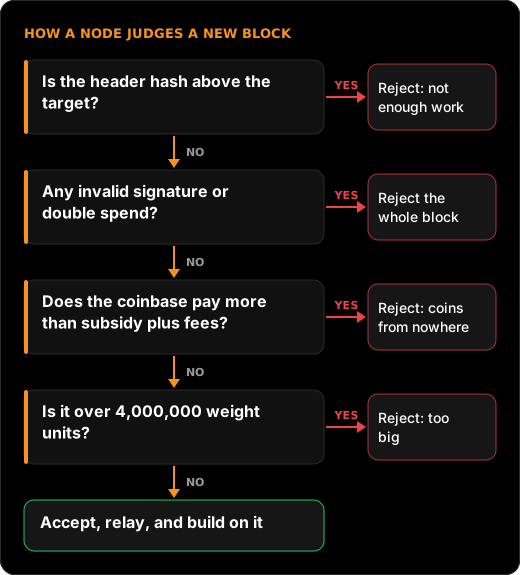
The key point is that a node's verdict does not depend on how much hashpower is behind a block. Nodes follow the valid chain with the most accumulated work. An invalid chain with more work is still invalid. Mining power decides between competing valid histories; it has no say over which rules make a history valid.
Not every node carries equal weight in practice. A node run by an exchange, a payment processor or a custodian decides which coins those businesses will accept. If the economy's nodes reject a block, the bitcoin in it is worthless to anyone trying to spend it there.
The Summer of 2017: A Live Test
Theory met reality during the block size fight. The Segregated Witness upgrade was deployed under BIP9, which asks miners to signal readiness and locks in a change once 95 percent of blocks in a 2,016-block period signal for it. Signaling opened in November 2016. For months, support among miners stayed well short of that threshold.
Node operators responded with BIP148, a "user-activated soft fork." Nodes running it would reject, starting August 1, 2017, any block that did not signal for segwit. Miners faced a choice: signal, or risk mining blocks a portion of the economy would refuse.
Segwit locked in that August and activated at block 481,824 on August 24, 2017. Separately, a group that wanted larger blocks split off on August 1 to create Bitcoin Cash, a different coin with its own rules. And a plan backed by major miners and companies, called SegWit2x, which would have doubled the block size later that year, was called off by its organizers in November 2017, before it took effect.
The 2021 Taproot upgrade went more smoothly, with a 90 percent signaling threshold. It activated at block 709,632 on November 14, 2021. Both episodes show the same pattern: rule changes stick only when the people running nodes adopt them.
Can Nodes Be Wrong?
Yes, and the history shows how fixes happen. On August 15, 2010, a transaction exploited an overflow bug to create more than 184 billion bitcoin. Developers released a patched version within hours. Nodes that upgraded rejected the bad block, miners built on the valid chain, and the honest chain overtook the bad one. The coins vanished from the ledger.
The fix worked because node operators chose to run it. No one could force them, and no one could have stopped them. That is the uncomfortable, robust truth: Bitcoin's rules are whatever its users' software enforces.
What This Means for You
- Hashpower is not ownership. Pool concentration is worth watching for censorship risk, but no pool can create coins or spend yours.
- Running a node is your vote. A node lets you verify your own payments against your own copy of the rules, without trusting anyone's server.
- Pair verification with self-custody. A node checks the rules; your keys control your coins. Many people combine a node with a hardware wallet.
- Rule changes are slow on purpose. Upgrades need broad adoption by node operators, which is why the supply schedule has held since 2009 through every dispute.
Miners write the blocks. Nodes decide which blocks are Bitcoin.