"I can't afford a bitcoin." It might be the most common sentence ever said about Bitcoin, and it rests on a misunderstanding.
Nobody needs to buy a whole bitcoin, any more than you need to buy a whole share of a gold mine to own an ounce of gold. Each bitcoin splits into 100 million smaller pieces called satoshis, or "sats" for short. If you buy $20 of bitcoin, you are not buying a sliver of something out of reach. You are buying thousands of whole satoshis.
Once that number sinks in, a lot of Bitcoin culture suddenly makes sense, including why so many people talk about "stacking sats."
One Hundred Million Pieces
A satoshi is one hundred-millionth of a bitcoin, written as 0.00000001 BTC. That is eight decimal places, and it is not a convention someone made up later. In Bitcoin Core, the software most of the network runs, every amount is stored internally as a whole number of satoshis. The value of one bitcoin is defined in the code as a single constant: 100,000,000.
In other words, the network itself does not think in bitcoin at all. It thinks in sats. "1 BTC" is just a friendly label for 100 million of them, the way "one dollar" is a label for 100 cents.
The unit is named after Satoshi Nakamoto, the pseudonymous creator who published the Bitcoin whitepaper in 2008 and later stopped communicating publicly. (That story is told in Meet Satoshi.) The community adopted the name for the smallest unit in Bitcoin's early years, and it stuck.
Bitcoin's Family of Units
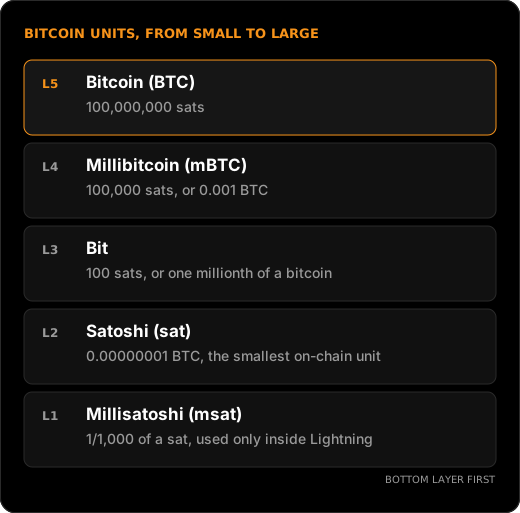
Over time, a few in-between units have appeared. You will mostly see BTC and sats, but here is the full family.
| Unit | In bitcoin | In satoshis | Where you see it |
|---|---|---|---|
| Bitcoin (BTC) | 1 | 100,000,000 | Prices, headlines |
| Millibitcoin (mBTC) | 0.001 | 100,000 | Occasionally in older wallets |
| Bit (also μBTC) | 0.000001 | 100 | Some wallets; defined in BIP 176 |
| Satoshi (sat) | 0.00000001 | 1 | Fees, small payments, everyday amounts |
| Millisatoshi (msat) | 0.00000000001 | 0.001 | Inside the Lightning Network only |
A BIP, or Bitcoin Improvement Proposal, is a public design document that describes a standard for the Bitcoin community. BIP 176, assigned in 2017, defined the "bit" as exactly 100 satoshis, an attempt to give people a unit with just two decimal places like the dollar. It never fully caught on; sats won the popularity contest.
Doing the Math Without a Calculator
Converting is easier than it looks. To get sats from BTC, move the decimal point eight places to the right. To get BTC from sats, move it eight places to the left.
- 0.01 BTC = 1,000,000 sats
- 0.0005 BTC = 50,000 sats
- 2,500 sats = 0.000025 BTC
Turning sats into dollars depends on the current price, so here is a purely hypothetical example. If one bitcoin were priced at $100,000, then one sat would be worth $0.001 (a tenth of a cent), and $20 would buy 20,000 sats. At any other price the numbers shift, but the method stays the same. The getBTC BTC/sats converter does it live, and the units card keeps the table above handy.
Analogy: Think of bitcoin like a meter and satoshis like millimeters, except far smaller. Nobody says "I walked 0.0015 kilometers." They say "I walked a meter and a half." Sats let people talk about everyday amounts of bitcoin without drowning in zeros.
Why the Smallest Unit Matters
There will never be more than 21 million bitcoin. Multiply that by 100 million and you get the total number of satoshis that can ever exist: about 2.1 quadrillion, or 2,100,000,000,000,000. (The 21 million cap explains why the true total lands slightly below that.)
That is a big number, but a fixed one. If bitcoin becomes more valuable over time, each satoshi buys more, and smaller amounts of sats become practical for everyday prices. That is why some Bitcoiners prefer to price things in sats rather than dollars: it is the unit that makes sense at the scale most people actually hold.
Satoshis also show up in the plumbing. Transaction fees, the small payment you attach so miners include your transaction in a block, are quoted in sats per virtual byte (a measure of how much space your transaction takes up). And Bitcoin Core refuses to relay tiny outputs it calls dust: amounts so small they would cost more in fees to spend than they are worth. Under the software's default settings, that line sits at 546 sats for a typical older-style output and 294 sats for the most common output type created by SegWit, a 2017 upgrade that changed how transaction data is stored.
Smaller Than a Satoshi: The Lightning Exception
On the main Bitcoin network, the satoshi is the end of the line. You cannot send half of one.
The Lightning Network, a payment layer built on top of Bitcoin for fast, small payments, goes one step further. Its specification counts amounts in millisatoshis, thousandths of a sat, so that tiny payments like per-second streaming fees can be tracked precisely. But when a Lightning balance settles back onto the main network, it is rounded to whole satoshis. The base layer only knows sats.
What This Means for You
- Ignore the price of one whole coin. You can own any number of sats, and buying a small amount works exactly like buying a large one. The first purchase guide shows how.
- Learn the eight-place shift. Moving the decimal eight places is all it takes to switch between BTC and sats.
- Read fees in sats. Wallets quote network fees in sats per virtual byte, so knowing the unit helps you judge whether a fee is high or low.
- Mind the dust. Very small amounts, a few hundred sats, can be uneconomical to move on-chain.
Bitcoin is not one expensive coin. It is 2.1 quadrillion small ones, and anyone can own some.