Most people's first bitcoin purchase goes something like this. A friend mentions it at dinner, you open an app that night, and twenty minutes later you are staring at a screen asking for a photo of your driver's license, wondering if you are about to make a mistake.
You probably are not. Buying bitcoin in 2026 is a regulated, fairly boring process, closer to opening a brokerage account than to anything shady. But a few decisions along the way do matter: which platform you use, how you pay, and what you do with the coins once you have them.
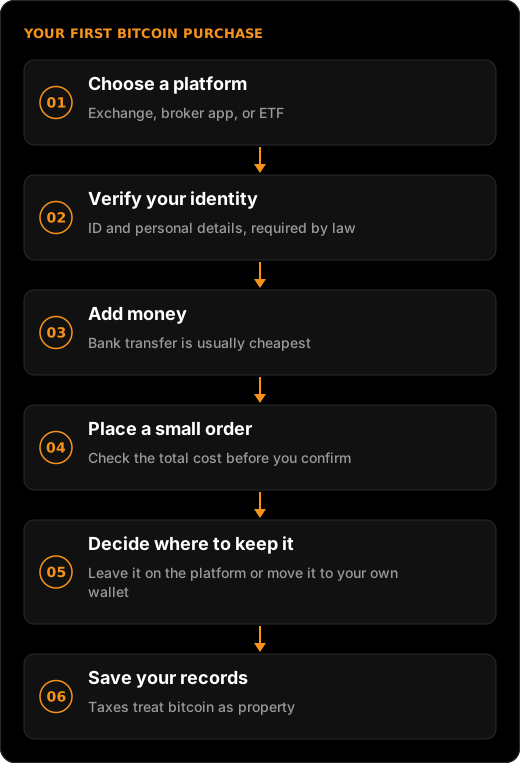
Here is the whole process, start to finish, with the choices that actually make a difference.
Step One: You Do Not Need a Whole Bitcoin
The most common beginner misconception is that you have to buy one entire bitcoin. You do not. Each bitcoin divides into 100 million tiny units called satoshis (or "sats"), so you can buy $10 or $20 worth just as easily as a whole coin. The satoshi explainer shows how those small amounts add up.
That makes the first decision easy: how much are you comfortable putting in? Bitcoin's price has fallen by more than half several times in its history. Many first-time buyers start with an amount small enough that a drop like that would be a lesson rather than a disaster. This is education, not advice, and the right number is yours to decide.
Step Two: Pick a Way In
There are four common ways for someone in the US to buy bitcoin. They are not equal.
| Option | What you own | Typical cost | Good to know |
|---|---|---|---|
| Crypto exchange (Coinbase, Kraken, Gemini) | Real bitcoin, held for you | Low to moderate fees | You can withdraw to your own wallet |
| Payment or broker app (Cash App, Robinhood, Strike) | Real bitcoin, held for you | Varies; check the spread | Convenient; withdrawal options differ by app |
| Spot bitcoin ETF | Shares of a fund that holds bitcoin | Annual fund fee | Lives in a normal brokerage account; you never hold the coins |
| Bitcoin ATM | Real bitcoin, sent to a wallet | Often the most expensive | A favorite tool of scammers |
A crypto exchange is a website or app where people trade bitcoin for dollars. An ETF (exchange-traded fund) is a fund you buy like a stock; the SEC approved the listing of the first spot bitcoin ETFs on January 10, 2024, and are covered in Bitcoin ETFs Explained. The getBTC exchange comparison lays out fees and features side by side.
One warning about ATMs: the US Federal Trade Commission reported in September 2024 that losses to bitcoin ATM scams topped $110 million in 2023, nearly ten times the 2020 figure, with people over 60 hit hardest. If anyone on the phone tells you to go to a bitcoin ATM, that is a scam, every time. The scams guide covers the other common tricks.
Step Three: Prove You Are You
Regulated US platforms will typically ask for your legal name, address, date of birth, Social Security number and a photo of a government ID. This is called KYC, short for "know your customer."
It is not optional, and it is a good sign. FinCEN, the Treasury bureau that enforces anti-money-laundering law, says in its 2019 guidance that businesses accepting and transmitting virtual currency like bitcoin are money transmitters. They must register with FinCEN and run an anti-money-laundering program, which includes verifying customers' identities. A platform that lets you skip identity checks entirely is a platform to be suspicious of.
Approval usually takes minutes, sometimes a day or two.
Step Four: Fund It and Place the Order
Next, connect a way to pay. A bank transfer is usually the cheapest option but can take a few days to clear. A debit card is instant but typically costs more. Some platforms do not accept credit cards at all, and some card issuers treat a crypto purchase as a cash advance, which comes with extra fees and interest.
When you buy, you will see two main order types:
- Market order: buy right now at the current price. Simple, and what most beginners use.
- Limit order: buy only if the price reaches a number you choose. Useful, but it may never fill.
Before confirming, look at the total, not just the bitcoin price. Platforms earn money through a visible fee and sometimes a spread, which is a markup built into the price itself. Comparing the amount of bitcoin you receive against the live price on the BTC/sats converter shows you what you really paid.
Analogy: Think of an airport currency exchange booth. The sign may say "zero commission," but the rate it gives you is worse than the real exchange rate, and that gap is where the booth makes its money. A spread works the same way, so the only number that tells the truth is how much you got for what you paid.
Step Five: Decide Where It Lives
Once the order fills, the bitcoin sits in your account on the platform. That is called custody: the company holds the secret keys that control the coins on your behalf.
Leaving coins there is convenient, but it means trusting that company. When the exchange FTX collapsed in November 2022, customers lost access to their funds, and the SEC later charged its founder with diverting customer money to his own crypto hedge fund. Many buyers eventually move their bitcoin to a wallet they control. Start with a small test withdrawal, confirm it arrives, then move the rest. Hot Wallets vs. Cold Wallets explains the options.
Step Six: Keep Your Receipts
For US taxes, the IRS treats bitcoin as property, not currency. Selling it, or spending it, can create a taxable gain or loss, and your tax return asks a yes or no question about digital assets. For sales on or after January 1, 2025, US brokers report the proceeds to the IRS on a new form, the 1099-DA, and for certain sales starting in 2026 they also report what you originally paid.
Download your transaction history at least once a year and save it. Your future self will thank you.
What This Means for You
- Start small on purpose. You can buy a few dollars of bitcoin, which makes it cheap to learn how everything works before any real money is involved.
- Pick the way in that fits your goal. An ETF gives price exposure inside a brokerage account; an exchange gives you real coins you can withdraw.
- Check the total cost. Fees and spreads vary widely between platforms. The first-buy guide walks through the checklist.
- Test before you move everything. A small withdrawal to your own wallet costs little and catches mistakes early.
- Treat any pressure as a red flag. Real platforms never call you and urge you to hurry.
Your first purchase is not about timing the market. It is about learning how the machine works.