For years, the SEC said no. Between 2018 and March 2023 alone, it disapproved more than 20 exchange filings for spot bitcoin funds, according to the SEC Chair's own statement. Then, on January 10, 2024, it approved eleven in a single order.
What changed was not bitcoin. It was a court ruling. Grayscale had sued after its application was rejected, and the US Court of Appeals for the D.C. Circuit held that the SEC "failed to adequately explain its reasoning." Faced with that ruling, the Commission approved the whole batch.
By June 30, 2026, just one of those funds, the iShares Bitcoin Trust, reported holding 734,261 bitcoin. That is real bitcoin, sitting with a custodian, owned by a fund you can buy with a stock ticker.
The Order That Opened the Door
The approval is SEC Release No. 34-99306. It covers rule changes filed by three exchanges (NYSE Arca, Nasdaq and Cboe BZX) to list eleven products, including the Grayscale Bitcoin Trust, the iShares Bitcoin Trust, the Fidelity Wise Origin Bitcoin Fund, the ARK 21Shares Bitcoin ETF and the Bitwise Bitcoin ETF.
Notice what the SEC approved: the exchanges' rules to list and trade these shares. Not bitcoin. Chair Gensler's statement that day was blunt: "While we approved the listing and trading of certain spot bitcoin ETP shares today, we did not approve or endorse bitcoin. Investors should remain cautious about the myriad risks associated with bitcoin and products whose value is tied to crypto."
A note on terms: the funds are legally trusts, often called ETPs (exchange-traded products) in filings, but almost everyone calls them ETFs. The wider rulebook is covered in US Bitcoin Regulation: Where Things Stand.
What Is Actually Inside the Fund
A spot bitcoin ETF is simple at its core. The trust owns bitcoin. Each share represents a slice of that bitcoin, minus fees. In its 10-Q, the iShares trust describes itself as having no officers, directors or employees; it is a container run by a sponsor, a trustee and service providers.
The fund values its holdings once a day, after 4:00 p.m. Eastern, using a published benchmark price. As of June 30, 2026, the iShares trust reported 734,261 bitcoin, a fair value of $43.40 billion, and a net asset value of $33.48 per share.
Analogy: Think of a gold ETF. You never touch a bar, but somewhere a vault holds metal that matches the shares outstanding. A spot bitcoin ETF works the same way, except the vault holds private keys instead of bars.
Who Holds the Keys
This is the part that differs most from owning bitcoin yourself. Each fund names a custodian in its filings.
| Fund (sponsor fee per filing) | Bitcoin custodian named in 10-Q for June 30, 2026 |
|---|---|
| iShares Bitcoin Trust (0.25%) | Coinbase Custody Trust Company; Anchorage Digital Bank as additional custodian |
| Fidelity Wise Origin Bitcoin Fund (0.25%) | Fidelity Digital Assets, N.A., an affiliate of the sponsor |
| Grayscale Bitcoin Trust (1.5%) | Coinbase Custody Trust Company; Anchorage Digital Bank as additional custodian |
Coinbase Custody shows up repeatedly, which is a real concentration point across the industry. How these custodians store keys (offline vaults, multi-party approval, insurance limits) is its own topic: see How Institutions Custody Billions in Bitcoin.
How Shares Are Created and Redeemed
You never buy shares from the trust. You buy them from other investors on the exchange. New shares come into existence through a separate wholesale process.
Per the iShares 10-Q, shares are created and redeemed only in "Baskets" of 40,000 shares, and only by registered broker-dealers called authorized participants. They hand the trust bitcoin or cash and receive a basket, or hand back a basket and receive bitcoin or cash. The SEC permitted in-kind creations and redemptions for the trust on July 29, 2025; before that, the process ran in cash.
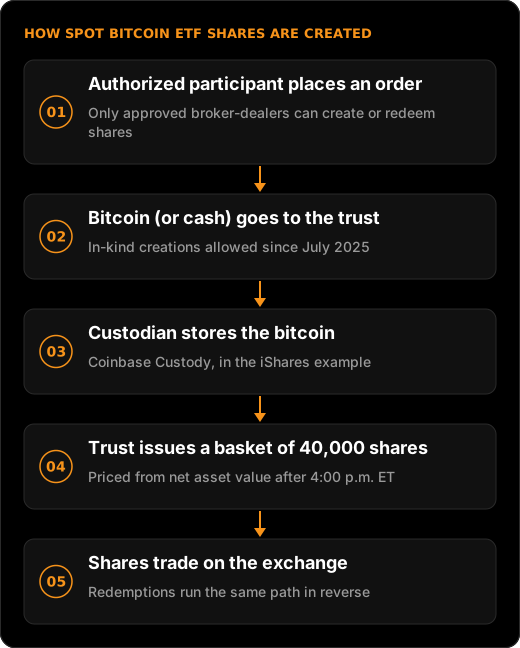
This arbitrage loop is what keeps the share price close to the value of the bitcoin inside. If shares trade above net asset value, authorized participants create more; if below, they redeem.
What It Costs, and What You Give Up
Fees are disclosed in the prospectus and repeated in every 10-Q. The iShares trust charges 0.25 percent a year, accrued daily; it collected $72.1 million in sponsor fees in the first half of 2026. The Grayscale Bitcoin Trust, which converted from an older trust structure, charges 1.5 percent. Over a decade, that gap compounds into a meaningful difference.
| Spot bitcoin ETF | Bitcoin in your own wallet | |
|---|---|---|
| Where it lives | Brokerage account, retirement accounts where offered | A wallet you control |
| Who holds the keys | The fund's custodian | You |
| Annual cost | Sponsor fee, 0.25% to 1.5% for the funds above | No ongoing fee; network fees when you move coins |
| Trading hours | Exchange hours only | 24/7 |
| Can you send it on-chain? | No | Yes |
The trade-off is convenience against control. An ETF share is a claim on bitcoin held by someone else. The hot vs. cold wallets guide covers the other path, and the hardware wallet comparison shows the devices people use for it.
What This Means for You
- Know what the approval meant. The SEC approved listing rules, and said in writing it did not endorse bitcoin.
- Read the fee line. Sponsor fees in these filings range from 0.25 to 1.5 percent a year, and they come out of the bitcoin held for you.
- Find the custodian. Every fund names who holds its keys. Concentration among a few custodians is a real, disclosed risk.
- Match the tool to the job. An ETF fits a brokerage or retirement account. It cannot be spent, sent or self-custodied.
An ETF share gives you bitcoin's price, while the keys stay with a custodian.