Imagine your employer announcing, years in advance and in writing, the exact day your pay will be cut in half. Then doing it again four years later. And again. Forever, until the paycheck rounds down to nothing.
That is the deal every Bitcoin miner signed up for. Roughly every four years, the number of brand-new bitcoin created with each block drops by 50 percent. It has happened four times since 2009, every time on schedule, and the fifth is already baked into the software for around 2028.
Most people hear about the halving as a price story. It is better understood as a supply story, and once you see the mechanics, it is one of the cleanest pieces of monetary engineering ever written.
A Pay Cut Written Into the Code
Every time a miner adds a valid block to the blockchain, they are allowed to pay themselves a fixed amount of new bitcoin. That amount is called the block subsidy. Together with the transaction fees inside the block, it makes up the block reward, which is the incentive for miners to keep securing the network. (The full machinery is in How Bitcoin Mining Actually Works.)
The subsidy started at 50 BTC per block in January 2009. The rule that shrinks it is short enough to quote in plain English: every 210,000 blocks, divide the subsidy by two. In Bitcoin Core, the reference software most of the network runs, this is a few lines in a function called GetBlockSubsidy. It counts how many 210,000-block intervals have passed and shifts the starting amount right by that many bits, which is the same as halving it each time.
Blocks arrive about every 10 minutes on average, so 210,000 blocks takes roughly 1,458 days. That is where "every four years" comes from. It is an approximation, not a calendar date, which is why each halving lands on a slightly different day.
Analogy: Think of a gold mine where the vein gets thinner on a schedule painted on the wall at the entrance. Every miner can read it. Nobody can repaint it. The only question is how many people decide the shrinking vein is still worth digging.
Four Halvings So Far
Because the trigger is a block height rather than a date, each halving is easy to verify on any block explorer. Here is the full record.
| Halving | Block height | Date (UTC) | Subsidy after |
|---|---|---|---|
| 1st | 210,000 | November 28, 2012 | 25 BTC |
| 2nd | 420,000 | July 9, 2016 | 12.5 BTC |
| 3rd | 630,000 | May 11, 2020 | 6.25 BTC |
| 4th | 840,000 | April 20, 2024 | 3.125 BTC |
| 5th | 1,050,000 | Expected around 2028 | 1.5625 BTC |
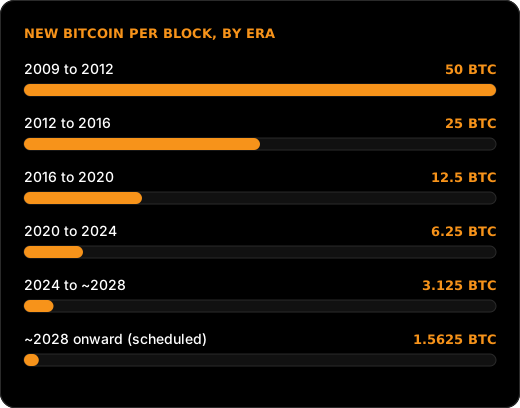
The pattern in that last column is the whole point. Each era issues half as many new coins as the one before it.
Why Halving Converges on 21 Million
Add up the eras and something neat happens. The first era issued 210,000 × 50 = 10.5 million BTC. The second issued 5.25 million. The third, 2.625 million. Each era adds half of what the previous one did, so the running total creeps toward a ceiling of 21 million without ever crossing it.
Because bitcoin cannot be divided below one satoshi (0.00000001 BTC), the subsidy eventually rounds down to zero. In the code, that happens after the 33rd halving, around the year 2140. Thanks to that rounding, the true maximum is a hair under 21 million. The 21 million cap article walks through that endgame in detail.
The practical consequence is that most of the bitcoin that will ever exist already does. With the subsidy at 3.125 BTC and about 144 blocks a day, the network now issues roughly 450 new bitcoin daily, about 164,000 a year, which is under 1 percent of the existing supply.
What the Halving Does Not Change
The halving cuts new issuance and nothing else. It does not change how fast blocks arrive, how transactions work, or how much bitcoin you hold. Your coins are not halved. Nobody's are.
It also does not change how hard miners must work per block in the short run. That job belongs to a separate mechanism, the difficulty adjustment, which retunes the mining puzzle every 2,016 blocks so blocks keep arriving about every 10 minutes no matter how many machines join or leave.
What the halving does change is miner economics. Overnight, half of the subsidy income disappears. Miners running older, less efficient machines can find themselves losing money on every block they attempt, and some switch off. The network shrugs: difficulty adjusts down, the remaining miners find blocks at the normal pace again, and security carries on.
The Fee Question Nobody Can Dodge
If the subsidy halves toward zero, what pays for security in 2140? The answer in the original design is transaction fees. The whitepaper says it directly: once a predetermined number of coins have entered circulation, the incentive can transition entirely to transaction fees.
Whether fees alone will be enough is one of the genuinely open debates in Bitcoin. Optimists point to fee spikes during busy periods and to layers like Lightning that batch many payments into few on-chain transactions. Skeptics worry that a security budget made only of fees could be thin. Both sides agree on one thing: the subsidy schedule itself is not up for negotiation, because changing it would require overwhelming agreement from the people running nodes. The details of who holds that power are in Nodes vs. Miners.
What This Means for You
- Treat the schedule as a known fact. You can calculate how much new bitcoin will exist in any future year. Few assets offer that, and no government currency does.
- Separate the event from the price. Past halvings have coincided with periods of intense public attention, but nothing in the code says anything about price. Anyone promising a halving rally is guessing.
- Remember your balance is untouched. The halving affects new coins paid to miners, never coins already held.
- Watch the fee story. As the subsidy shrinks, fees become a bigger share of miner income. That shift is the long-term question worth following.
- Think in timeframes, not moments. If you are building a position slowly, the DCA calculator shows how regular buys behaved across past halving cycles.
The paycheck halves on schedule, every time, whether anyone is watching or not.