Ask ten people at a barbecue what they know about Bitcoin and you will hear the same handful of lines. It is what criminals use because nobody can trace it. It gets hacked every other week. It is basically illegal. The government could shut it off tomorrow. And if you send money to the wrong place, you just call someone and get it back.
Every one of those sentences is wrong, and a couple of them are wrong in ways that can cost you money.
Our What is Bitcoin? guide already tackles the big-picture myths about energy, crime levels and bubbles. This article goes after five different ones, the practical misunderstandings that trip people up once they actually start using Bitcoin. For each, we checked the claim against a primary record: a court filing, a tax notice, a software bug report, or the blockchain itself.
Myth 1: "Nobody Can Trace Bitcoin"
Bitcoin is not anonymous. It is pseudonymous, which means your activity is tied to a made-up label instead of your name. That label is an address, a string of letters and numbers that works like an account number for receiving bitcoin.
Here is the catch: every transaction ever made sits on the blockchain, a public record that anyone can read. The original Bitcoin design document, the 2008 whitepaper, says so directly: "The public can see that someone is sending an amount to someone else, but without information linking the transaction to anyone." The privacy depends entirely on nobody connecting your name to your address. The moment you buy bitcoin on a regulated exchange that checked your ID, that link exists.
The best-known proof came in 2021. After the Colonial Pipeline ransomware attack, the US Department of Justice announced in June that it had seized 63.7 bitcoin of the ransom, then valued at about $2.3 million. Investigators followed the payment across the public ledger to a specific address. Cash would not have left that trail.
Myth 2: "Bitcoin Gets Hacked All the Time"
This myth mixes up two very different things: the Bitcoin network, and companies that hold bitcoin for customers.
Companies do get hacked. Mt. Gox, a major early bitcoin exchange, collapsed in 2014 after customer bitcoin went missing. But that was a business losing coins it was storing, the way a bank vault can be robbed without anyone "hacking the dollar."
The network itself is a different story. Its rules, such as who owns which coins and how many can ever exist, are checked independently by thousands of computers called nodes. The best-known failure in its history was a software bug in August 2010, recorded as CVE-2010-5139, that let someone create about 184 billion bitcoin out of thin air in one transaction. Developers published a fix within hours, updated nodes rejected the bad block, and those coins never became part of the accepted record. It is a real case of the protocol itself failing, and it happened in Bitcoin's second year.
Analogy: Think of the Bitcoin network as the rules of chess and an exchange as a chess club. A club can be burgled and its trophies stolen. Nobody concludes that the rules of chess were hacked.
Myth 3: "Bitcoin Is Illegal"
In the United States, owning and using bitcoin is legal, and two federal agencies treat it as a normal part of the financial landscape.
The IRS settled the tax question back in 2014. Notice 2014-21 states that "for federal tax purposes, virtual currency is treated as property." That means selling bitcoin at a profit can create a taxable gain, just like selling a stock.
Then on January 10, 2024, the Securities and Exchange Commission approved the listing and trading of several spot bitcoin exchange-traded products: funds that hold actual bitcoin and trade on a stock exchange, so people can get bitcoin exposure in an ordinary brokerage account.
Legality does vary by country, and some governments restrict trading or mining. "Legal everywhere" would be a myth too. But "illegal" is not an accurate description of Bitcoin's status in the US.
Myth 4: "A Government Could Switch It Off"
Bitcoin has no headquarters, no main server and no off switch. A real-world test came in 2021, when Chinese authorities moved against bitcoin mining (the computing work that adds new blocks to the blockchain) and trading, and many miners there had to unplug or move.
The network's response is visible on any block explorer. Bitcoin automatically retunes its mining puzzle every 2,016 blocks so that blocks keep arriving about every 10 minutes, a mechanism called the difficulty adjustment. On July 3, 2021, at block 689,472, the difficulty dropped by about 28 percent, the largest downward adjustment on record, a drop widely linked to miners going offline in China. The remaining miners picked up the slack, blocks kept coming, and nobody's coins disappeared.
A government can make Bitcoin hard to buy inside its borders. Turning off the network everywhere is a different and far harder problem.
Myth 5: "If Something Goes Wrong, Someone Can Undo It"
This is the myth that costs beginners the most. Card payments can be disputed and bank transfers can sometimes be recalled because a company sits in the middle. Bitcoin removed that middleman on purpose. The whitepaper describes the goal as payments that are "computationally impractical to reverse."
Bitcoin.org puts it plainly: a Bitcoin transaction "cannot be reversed, it can only be refunded by the person receiving the funds." There is no Bitcoin customer support line. If you send to the wrong address or to a scammer, getting it back depends on the receiver's goodwill, which is why scammers love crypto payments. The full step-by-step picture is in What Happens When You Send Bitcoin.
The Scorecard
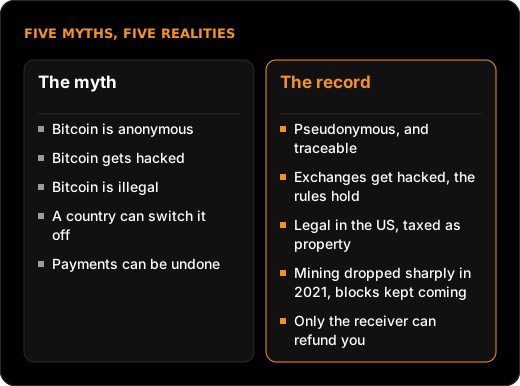
| Myth | What the record shows | Where to check |
|---|---|---|
| Bitcoin is anonymous | Every transaction is public; addresses can be linked to people | 2008 whitepaper, section 10; DOJ seizure, June 2021 |
| Bitcoin gets hacked | Exchanges have failed; the best-known protocol bug was fixed within hours in 2010 | CVE-2010-5139 |
| Bitcoin is illegal | Legal in the US, taxed as property, spot ETPs approved | IRS Notice 2014-21; SEC, January 10, 2024 |
| A country can switch it off | Mining dropped sharply in 2021; difficulty fell about 28 percent and blocks continued | Block 689,472 on any explorer |
| Payments can be undone | Only the receiver can send a refund | Bitcoin.org, "Some things you need to know" |
What This Means for You
- Assume your transactions are visible. Treat every address as public and remember that exchanges know who you are.
- Separate the network from the company. When you read "Bitcoin hacked," check whether it was the protocol or a business holding coins.
- Know your local rules. In the US, bitcoin is legal and taxed as property, so keep records of what you buy and sell.
- Double-check before you send. Payments are final. Test with a small amount first; the sats converter helps you size it.
- Check claims against records. Block explorers, court filings and tax notices are public. Use them before repeating a headline.
The most useful Bitcoin skill is not predicting anything. It is checking.