It starts with a text that was clearly meant for someone else. "Hi, is this Emma? Are we still on for golf Saturday?" You reply to say wrong number. They apologize, they are friendly, and a few weeks of pleasant chat later, your new friend mentions the crypto trading app that has been doing wonders for their savings.
That slow, friendly approach is exactly how the FBI's 2025 IC3 Annual Report describes crypto investment fraud: contact by text, social media, an ad or a dating app, then a move to a fake investment platform. Complaints involving cryptocurrency reported $11.366 billion in losses that year, more than half of the $20.877 billion total reported to the FBI. Crypto investment fraud alone accounted for $7.228 billion.
The good news is that scams are repetitive. The same few scripts account for most of the damage, and once you can recognize them, they lose most of their power.
The Numbers Behind the Warnings
These figures come straight from the FBI's Internet Crime Complaint Center (IC3) report for 2025. They count only what victims chose to report, so the real totals are likely higher.
| Scam type (2025) | Complaints | Reported losses |
|---|---|---|
| All complaints involving crypto | 181,565 | $11.366 billion |
| Crypto investment fraud | 61,559 | $7.228 billion |
| Recovery scams | 10,516 | $1.4 billion |
| Crypto ATM and kiosk scams | 13,460 | $389 million |
Age matters. People 60 and older reported $4.43 billion of the crypto losses, more than any other age group. The Federal Trade Commission (FTC) found the same pattern for Bitcoin ATMs in its September 2024 data: adults over 60 were more than three times as likely as younger adults to report losing money through one.
The Slow Build: Fake Investment Platforms
Regulators call this a relationship investment scam. A joint alert from the SEC, CFTC, FINRA and NASAA (federal, state and industry financial watchdogs) notes it also goes by "romance scam" and what the alert calls "the distasteful term" pig butchering: victims are fattened up with trust before the slaughter.
The pattern, per the FBI and the SEC:
- Contact starts by text message, social media, an online ad or a dating app.
- Weeks of friendship or romance come before any mention of money.
- You are steered to a professional-looking app or website, sometimes even one in a real app store.
- The app shows impressive fake profits. A small early withdrawal may even work, to build trust.
- When you try to take out real money, a "tax" or "fee" suddenly has to be paid first. It never ends.
The FTC's rule of thumb fits on a sticky note: "Never mix online dating and investment advice."
The Panic Call: Impersonators and Bitcoin ATMs
The second big script is about fear, not greed. Someone claiming to be from your bank, a government agency, or a tech support team says your accounts are compromised. The fix, they insist, is to pull out cash and feed it into a Bitcoin ATM, a kiosk that turns cash into bitcoin, to "protect" it.
The FTC describes what happens next: victims scan a QR code the scammer provides, and their cash is deposited straight into the scammer's crypto account. The FTC reported that Bitcoin ATM scam losses grew nearly tenfold from 2020 to 2023, reaching more than $110 million in 2023 alone.
The FTC is blunt about this one: "Only scammers demand payment in cryptocurrency." No real government agency or business will ask you to pay at a Bitcoin ATM.
Analogy: A Bitcoin ATM scam is like a stranger calling to warn you about burglars, then asking you to move your valuables into their car for safekeeping. The urgency is the trick. Real protection never needs you to hand things to the caller.
Fake Giveaways and Fake Helpers
Three smaller scripts round out the list:
- Giveaways. "Send 0.1 BTC, get 0.2 BTC back," often dressed up with a famous name or a faked video. The FTC's line: "Scammers promise free money."
- Fake support. You post about a wallet problem online and a "support agent" messages you. Their fix always involves your seed phrase, the list of 12 to 24 words that can rebuild your wallet. Anyone holding those words controls your bitcoin. Real support never asks for them. (Why that phrase matters so much is covered in Hot Wallets vs. Cold Wallets.)
- Lookalike sites and apps. A search ad or a link in an email leads to a near-perfect copy of a real exchange. You log in, and they now have your password.
The Second Punch: Recovery Scams
Once someone has lost money, they get targeted again. "Recovery" firms, sometimes posing as law firms or even as the FBI's IC3 itself, promise to get the stolen crypto back for an upfront fee. The FBI logged 10,516 recovery scam complaints in 2025 with about $1.4 billion in reported losses (that figure can include the original scam that set the victim up).
Remember why this works. Bitcoin payments are final; once sent, only the receiver can return them. Nobody can reverse the transaction for a fee. That finality is covered in Bitcoin Myths Debunked.
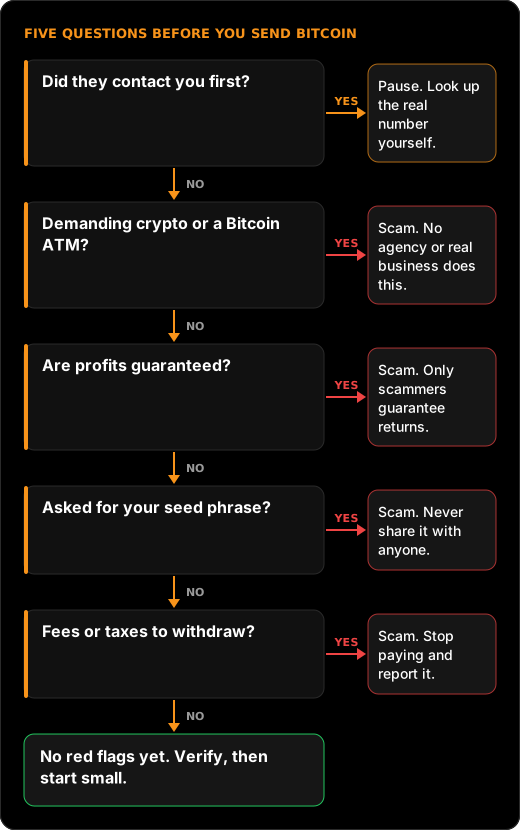
Five Questions That Stop Most Scams
Before sending bitcoin to anyone, run through these. One yes is enough to stop.
If you are buying for the first time, the safest habit is to start from a platform you found yourself rather than one a contact recommended. Our first-buy guide walks through the steps.
What This Means for You
- Treat unsolicited contact as suspect. Hang up or stop replying, then contact the bank, agency or company using a number you look up yourself.
- Never share your seed phrase. Not with support staff, not with a friend, not with anyone who messages you about it.
- Read "guaranteed" as a warning. Real investments carry risk. Anyone promising otherwise is running a script.
- Report it, even if it is embarrassing. File with the FBI at ic3.gov and with the FTC at ReportFraud.ftc.gov. Reports feed the data that warns the next person.
- Ignore anyone selling recovery. If someone offers to get your lost crypto back for a fee, that is the next scam.
Scammers need you to hurry, so the best defense is simply slowing down.