On September 15, 2022, Ethereum, one of the largest blockchains in the world, changed its engine while it was running. It switched off mining entirely and replaced it with staking. According to ethereum.org, the change cut the network's energy consumption by roughly 99.95 percent.
If a fix that dramatic exists, the obvious question is why Bitcoin has not done the same. Is it stubbornness, or is there something proof of work does that proof of stake cannot?
The honest answer is that both are serious engineering, built to solve the same problem with different trade-offs. Understanding those trade-offs is more useful than picking a team.
The Problem Both Are Solving
Any open ledger without a central operator has to answer one question over and over: who gets to write the next page? If the answer is "whoever asks," an attacker can create a million fake identities and outvote everyone. This is called a Sybil attack, and every public blockchain needs a way to make votes cost something real.
Section 4 of the Bitcoin whitepaper gives its answer in one phrase: "Proof-of-work is essentially one-CPU-one-vote." Votes are weighted by computation, which costs money, and identities are free but useless without it. Proof of stake answers differently: votes are weighted by coins locked up as collateral.
How Proof of Work Earns Its Security
In Bitcoin, miners repeatedly hash a block header until they find a result below a target. The first to succeed publishes the block and collects the reward. Every node can check that work instantly, but producing it took real energy and specialized hardware. The whitepaper describes its design as "a proof-of-work system similar to Adam Back's Hashcash." The mechanics are covered in How Bitcoin Mining Actually Works, and the way the target retunes itself every 2,016 blocks in Difficulty Adjustment.
The key property is that the cost lives outside the system. To rewrite history, an attacker must outpace the honest network's hash rate in the physical world, buying machines and electricity. The whitepaper's section 11 shows that the probability of an attacker with a minority of hash power catching up drops exponentially with each block added on top.
Analogy: Proof of work is like a ledger carved into stone, where each new page takes a day of chiseling. Anyone can check the carvings, and forging an old page means re-carving every page after it, faster than everyone else is carving new ones.
How Proof of Stake Earns Its Security
In Ethereum's proof of stake, according to ethereum.org, a validator deposits 32 ETH into a deposit contract. Time is divided into 12-second slots, grouped into 32-slot epochs. In each slot, one validator is chosen to propose a block and committees of others vote on it.
Two features stand out. First, explicit finality: when checkpoints attract votes representing at least two thirds of all staked ETH, they become finalized, and reversing them would require destroying a huge amount of stake. Second, slashing: validators caught doing provably malicious things, such as signing two conflicting blocks, lose part or all of their deposit. Proof of work can only make an attack expensive. Proof of stake can also confiscate the attacker's capital.
Ethereum.org lists the pros plainly: far less energy, lower issuance needed to pay for security, and easier participation through staking pools. It is equally plain about the cons: proof of stake is younger, less battle tested and more complex to implement than proof of work.
The Trade-Offs, Side by Side
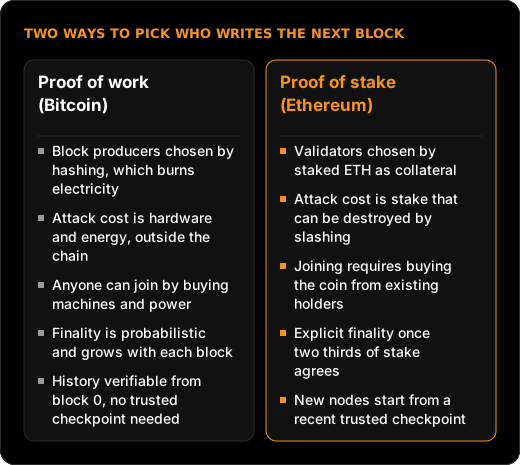
| Proof of work (Bitcoin) | Proof of stake (Ethereum) | |
|---|---|---|
| Scarce resource | Electricity and mining hardware | The network's own coin, locked as stake |
| Joining as a block producer | Buy machines and power from anyone | Acquire 32 ETH, from existing holders |
| Energy use | High by design | About 99.95 percent lower than Ethereum's PoW era |
| Finality | Probabilistic, deepens with each block | Explicit checkpoints with two thirds of stake |
| Punishing attackers | Wasted energy and hardware costs | Slashing destroys the attacker's deposit |
| Syncing a new node | Verify all work from the genesis block | Start from a recent checkpoint obtained socially |
| Years in operation on a major chain | Since January 2009 | Since September 2022 on Ethereum |
Why Bitcoin Stayed With Work
Bitcoin's defenders tend to emphasize three properties that follow from keeping the cost outside the chain.
Objective history. A brand-new Bitcoin node needs nothing but the software and the network. It downloads the blocks and picks the valid chain with the most accumulated work, with no need to trust anyone about which history is real. Ethereum's own documentation says subjectivity is inherent to proof-of-stake blockchains, and Ethereum limits it with "weak subjectivity checkpoints": a new node needs a recent checkpoint obtained from a trusted source. Weak subjectivity is defined there as "a chain that can progress objectively after some initial seed of information is retrieved socially." That is a deliberate design choice with known mitigations, but it is a difference in kind.
Permissionless entry. Anyone can start mining by purchasing hardware and electricity, neither of which is controlled by existing bitcoin holders. In proof of stake, the right to produce blocks must be bought from people who already hold the coin, so influence over consensus follows existing wealth in that coin.
Simplicity. Bitcoin's consensus rule fits in a sentence: follow the valid chain with the most work. Fewer moving parts means fewer places for subtle bugs, which matters for a system holding value on this scale.
Critics have real points too. Mining consumes large amounts of energy, ethereum.org notes that it requires costly specialized equipment, and mining pools concentrate block production in a handful of operators. Whether miners can censor transactions or change rules is a separate question, answered in Nodes vs. Miners: nodes, not miners, enforce the rules.
The Energy Question, Honestly
Bitcoin's energy use is not a bug waiting for a patch. It is the security mechanism itself: the cost of producing blocks is exactly what makes rewriting them expensive. Removing it would mean replacing the security model, not tuning it.
Whether that cost is worth paying is a values question, not a technical one. Supporters argue a neutral, hard-to-capture settlement layer is worth a real-world price. Critics argue the same security can be had more cheaply. Both are making a judgment about trade-offs that the code cannot settle for them.
What This Means for You
- Know what secures what you hold. Bitcoin relies on external energy cost, and proof of stake chains rely on locked capital. Each has distinct failure modes.
- Holding is not securing. Bitcoin in self-custody plays no part in consensus and earns no staking yield, which is why storage choices like hardware wallets are purely about safety.
- Separate the engineering from the marketing. "Green" and "secure" are both trade-off claims. Primary sources like the whitepaper and ethereum.org state the costs plainly.
- Expect the debate to continue. Proof of stake has run Ethereum since 2022 and proof of work has run Bitcoin since 2009, and both are still accumulating track record.
Bitcoin chose to pay for security in the physical world, and it pays the bill every ten minutes.