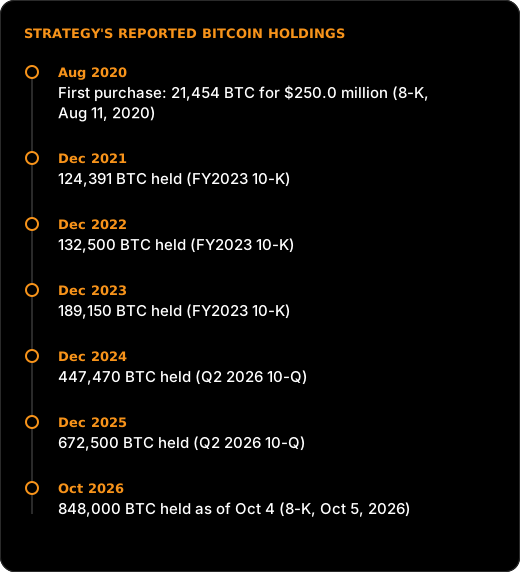
On August 11, 2020, a business intelligence software company in Tysons Corner, Virginia, filed a routine-looking Form 8-K. It said the company had bought 21,454 bitcoin for $250.0 million, fees included. The filing said the money came from assets not required for working capital. To most observers, it looked eccentric.
Six years later, the same company is called Strategy Inc, and its Form 8-K filed October 5, 2026 reports 848,000 bitcoin, bought for an aggregate $63.97 billion. That is roughly 4 percent of the 21 million bitcoin that will ever exist, held by one listed company.
How does a software firm end up calling itself the largest corporate holder of bitcoin? Not by selling more software. It did it by turning its stock, bonds and preferred shares into a machine for buying bitcoin, and the filings show every turn of the crank.
The $250 Million Opening Move
The 2020 press release, attached to that 8-K, framed the purchase as a treasury decision, not a bet on technology. Michael J. Saylor, then CEO and today Executive Chairman, said the investment reflected the company's belief that bitcoin is "a dependable store of value and an attractive investment asset with more long-term appreciation potential than holding cash."
The same filing added new risk factors on day one: bitcoin's price is "highly volatile", and any decline below carrying value could force an impairment charge. Those two ideas, conviction plus disclosed risk, run through every filing since.
The early buys used cash on hand. Borrowing followed quickly: the company's 10-Q notes that in February 2021 alone it issued $1.05 billion of convertible notes. From then on, the treasury grew faster than the software business could ever fund on its own. The wider 2020 moment is covered in the Bitcoin History Timeline.
From MicroStrategy to Strategy
On February 5, 2025, the company's fourth quarter earnings release opened with a new name: "MicroStrategy Incorporated d/b/a Strategy". The release called it "the world's first Bitcoin Treasury Company". Its 2026 filings now carry the legal name Strategy Inc, "formerly known as MicroStrategy Incorporated", and the ticker remains MSTR.
The rename matched what the numbers already showed. The company still sells analytics software, and its 10-Q still reports a Software segment, but the bitcoin segment now dominates its results in both directions.
How the Bitcoin Machine Gets Funded
Strategy does not mine bitcoin and earns comparatively little from software. It buys bitcoin mostly by selling securities to investors and spending the proceeds. Its 10-Q for the quarter ended June 30, 2026 spells out the sources quarter by quarter.
| Funding tool | What investors get | Disclosed example |
|---|---|---|
| Class A common stock (MSTR) sold "at the market" | Shares in the company | About 58.5 million shares sold in the first half of 2026 for about $8.24 billion net |
| Convertible notes | Debt that can turn into shares | About $6.71 billion principal of convertible notes outstanding as of June 30, 2026 |
| Perpetual preferred stock (STRF, STRC, STRK, STRD) | Fixed or variable dividends, no maturity | $5.46 billion of STRC proceeds funded bitcoin in Q2 2026 |
| Cash on hand | Nothing; it is the company's own money | $13.0 million of USD cash funded part of the October 1 to 4, 2026 buys |
The preferred shares matter more each year. Per its 8-K filed October 1, 2026, Strategy kept the STRC dividend rate at 12.00 percent per year for periods starting October 16, 2026. Those dividends must be paid in dollars, whatever bitcoin does.
Analogy: Picture a landlord who keeps buying buildings with mortgages and investor money, betting that property values rise faster than the interest bill. It works beautifully while prices climb. When prices fall, the interest is still due every month, and the landlord may have to sell a building to pay it.
When the Price Falls Below Cost
That analogy is not hypothetical. The June 30, 2026 10-Q reports 846,000 bitcoin with an original cost of $63.94 billion but a fair value of $49.67 billion. Since adopting fair value accounting in 2025, the company runs those swings straight through its income statement, and it recorded a $22.77 billion unrealized loss on digital assets for the first six months of 2026. The mechanics of that accounting are explained in Bitcoin Treasury Accounting, Explained Simply.
The same filing discloses two responses. First, in Q2 2026 the company sold about 1,395 bitcoin, with the proceeds "used to fund dividend payments on Preferred Stock". Second, the board adopted a USD Reserve policy requiring cash equal to at least 12 months of expected preferred dividends and interest; the reserve stood at $2.40 billion as of June 30, 2026.
The Criticisms, Fairly Stated
Supporters point to the company's "BTC Yield", its own measure of growth in bitcoin per share. Critics point to risks the filings themselves describe.
- Dilution. Selling new shares to buy bitcoin spreads ownership thinner. The 10-Q notes that when share sales fund dividends instead of bitcoin, they reduce the company's own "BTC Yield" metric.
- Fixed obligations against a volatile asset. Interest and preferred dividends are owed in dollars. Bitcoin pays nothing.
- Concentration. One volatile asset dominates the balance sheet, so the company's fortunes track a single price.
- Price below cost. As of June 30, 2026, the bitcoin was worth less than the company paid for it.
None of this predicts what happens next. It is what the company itself tells regulators could go wrong. For the broader corporate picture, see Why Corporations Hold Bitcoin on Their Balance Sheets.
What This Means for You
- Read the 8-K, not the headline. Strategy files bitcoin updates with the SEC, usually weekly. The holding count, cost and funding source are all there, dated.
- Separate the stock from the coin. MSTR shares carry software risk, debt, preferred dividends and dilution on top of bitcoin's price. They are a different instrument with different risks.
- Watch the obligations. The size of dividend and interest commitments relative to cash reserves is the number that tells you how much room the company has in a downturn.
- Check the as-of date. Holdings here are as of October 4, 2026. They will have changed by the time you read this.
- Test the timing yourself. The ROI calculator shows how bitcoin itself moved from August 2020 to today, without leverage.
One company turned a cash management decision into an 848,000-coin treasury, and filed every step.