Imagine buying a house for $300,000, watching the market dip so you write its value down to $250,000, then watching it climb to $600,000. Now imagine your accountant insisting your books still show $250,000, because the rules allow write-downs but never write-ups. Until recently, that was how US companies had to account for bitcoin.
It produced absurd results. A company could hold bitcoin worth far more than it paid, while its financial statements showed a stream of impairment losses. Investors learned to ignore the reported number and look up the holdings themselves.
In December 2023, the Financial Accounting Standards Board (FASB), which writes US accounting rules, fixed that with Accounting Standards Update 2023-08. Here is what changed, when, and what it looked like on a real balance sheet. Everything below is current as of October 7, 2026.
The Old Rule: Only Down, Never Up
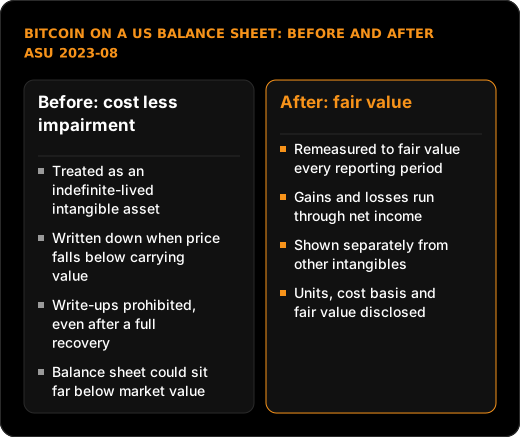
Before the update, US GAAP had no specific standard for bitcoin. Companies treated it as an "indefinite-lived intangible asset," the same bucket as a trademark. ASU 2023-08 describes that old model directly: those assets were tested for impairment, and if the carrying amount exceeded fair value, the company had to record an impairment loss. Then the key line: "Subsequent increases in the carrying amount of the asset and reversal of an impairment loss are prohibited."
So a single bad day could lock in a write-down forever. The gain only appeared when the bitcoin was sold.
Analogy: Think of a thermometer that can only show lower temperatures. It records every cold snap faithfully, but on the hottest day of summer it still reads the coldest morning of winter. Accurate about the past, useless about today.
The New Rule in Plain English
ASU 2023-08 created Subtopic 350-60 for crypto assets. Its core requirement is that a company "measure crypto assets at fair value in the statement of financial position each reporting period and recognize changes from remeasurement in net income."
Three practical changes follow:
- Fair value on the balance sheet. The bitcoin line now reflects the market price at period end, not historical cost minus write-downs.
- Changes hit net income. Price moves flow through the income statement every quarter, up or down.
- More disclosure. For each significant holding, the company discloses the name, cost basis, fair value and number of units.
The scope is narrower than "all crypto." An asset qualifies only if it is an intangible asset, gives no enforceable rights to underlying goods or services, lives on a blockchain, is secured by cryptography, is fungible, and was not issued by the reporting company or its related parties. Bitcoin meets all six.
When It Took Effect
The update is effective "for fiscal years beginning after December 15, 2024, including interim periods within those fiscal years." For a calendar-year company, that means January 1, 2025. Early adoption was permitted.
Adoption is not retrospective. Instead, a company records the cumulative effect of the change as a one-time adjustment to the opening balance of retained earnings as of the start of the year it adopts. Past periods are not restated, so results before and after adoption are not directly comparable.
One Balance Sheet, Overnight
The clearest real example is Strategy, the largest corporate holder (its story is in Strategy: The Company That Bet Everything on Bitcoin). Its Form 10-Q for the first quarter of 2025 shows what adoption did on January 1, 2025, in thousands of dollars:
| Line item | Dec 31, 2024 (as reported) | Effect of ASU 2023-08 | Jan 1, 2025 (as adjusted) |
|---|---|---|---|
| Digital assets | $23,909,373 | +$17,881,048 | $41,790,421 |
| Deferred tax assets | $1,525,307 | ($1,165,605) | $359,702 |
| Deferred tax liabilities | $407 | +$3,969,065 | $3,969,472 |
| Accumulated deficit / retained earnings | ($2,166,876) | +$12,746,378 | $10,579,502 |
Nothing about the bitcoin changed between December 31 and January 1. The company simply stopped carrying it at written-down cost. The adjustment turned an accumulated deficit of about $2.2 billion into retained earnings of about $10.6 billion, net of a new deferred tax liability.
The Price of Honesty: Volatile Earnings
Fair value makes the balance sheet more accurate and the income statement much louder. Strategy's own filings show the swing. For the quarter ended March 31, 2025, it reported an unrealized loss on digital assets of $5.91 billion. For the quarter ended June 30, 2025, it reported an unrealized gain of $14.05 billion. Its 10-Q warns that "significant variances in gains and losses could occur in future quarters."
Readers of any company with large holdings, including the miners described in The Public Bitcoin Mining Industry, now need to separate operating results from bitcoin's mark to market. A paper gain is not cash, and a paper loss is not a sale. To see how much of a change is just price, the ROI calculator does the arithmetic for any purchase price and date.
Accounting Is Not Taxes
Fair value accounting does not mean the IRS taxes unrealized gains. For regular federal income tax, bitcoin is property and gains are generally taxed when realized. The wrinkle was the corporate alternative minimum tax, which starts from financial statement income. In Notice 2025-49, Treasury and the IRS issued interim guidance that, depending on the accounting principles applied, can let a company disregard fair value gains and losses on items such as "holdings of digital assets" that are not marked to market for regular tax purposes. It is interim guidance, pending proposed regulations.
Outside the US, the picture differs. ASU 2023-08's basis for conclusions notes that IFRS allows revaluation of intangibles with an active market, with gains above cost going to other comprehensive income rather than profit. Comparing a US filer to an IFRS filer means reading the notes, not just the headline numbers. Why companies hold bitcoin in the first place is covered in Why Corporations Hold Bitcoin on Their Balance Sheets.
What This Means for You
- Expect big swings in reported profit. Under fair value, a bitcoin-heavy company's net income moves with the price every quarter.
- Look for the unrealized line. Search filings for "unrealized gain" or "unrealized loss on digital assets" to separate price effects from operations.
- Mind the January 2025 break. Results before and after adoption are not directly comparable, because prior periods were not restated.
- Use the disclosures. Units held, cost basis and fair value are now required, so you rarely need outside trackers.
- Do not confuse books with taxes. An accounting gain is not a taxable sale under regular tax rules.
The bitcoin did not change on January 1, 2025. The thermometer did.