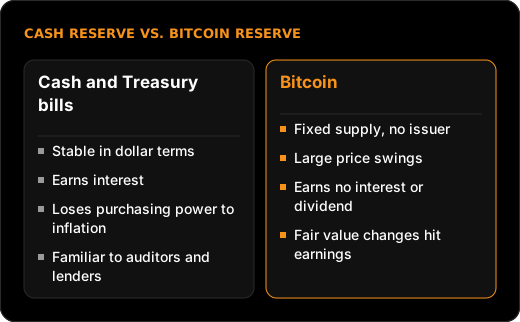
A corporate treasurer's job is to make sure the company never runs out of money. The classic tools are dull on purpose: bank deposits, Treasury bills, money market funds. Nobody gets promoted for a clever cash balance, but plenty get fired for a lost one.
So it is worth asking why a number of public companies have put bitcoin, an asset that has fallen more than 50 percent several times in its history, into the same part of the balance sheet. The answer is not in press coverage. It is in the filings, where companies have to explain their reasoning and list the risks under legal liability.
Read them side by side and three distinct motives appear. They lead to very different outcomes.
Motive One: Cash Is Losing Value
An early landmark is MicroStrategy's August 11, 2020 press release, filed as an exhibit to an 8-K. It argued that macro conditions, including "unprecedented government financial stimulus measures including quantitative easing", could have "a significant depreciating effect on the long-term real value of fiat currencies."
The company concluded bitcoin was "a dependable store of value and an attractive investment asset with more long-term appreciation potential than holding cash." Note the comparison: not bitcoin versus stocks, but bitcoin versus cash. That framing recurs in treasury filings ever since.
The underlying idea is covered in Why Does Bitcoin Have Value?: a fixed supply that no central bank can expand.
Motive Two: Diversifying Spare Cash
Tesla took a narrower path. Its 10-K for fiscal 2020, filed February 8, 2021, says the company updated its investment policy in January 2021 "to provide us with more flexibility to further diversify and maximize returns on our cash that is not required to maintain adequate operating liquidity." It then "invested an aggregate $1.50 billion in bitcoin."
This is bitcoin as a slice of surplus cash, not a corporate identity. And it came with an exit. Tesla's 10-Q for the quarter ended June 30, 2022 reports that the company had "converted approximately 75% of our purchases into fiat currency."
Tesla still holds the rest. Its 10-Q for the quarter ended June 30, 2026 reports "11,509 units of Bitcoin held at an acquisition cost of $386 million," with digital assets carried at $674 million.
Motive Three: Bitcoin Is the Business Plan
The third group goes furthest. For these companies, bitcoin is not a side allocation; it is the strategy. They raise money from investors specifically to buy more.
Strategy, the renamed MicroStrategy, is the template. Its 10-Q for the quarter ended June 30, 2026 reports 846,000 bitcoin, funded largely by selling common stock, convertible notes and preferred stock. Strive's 10-K for fiscal 2025 goes further in its language, describing bitcoin as its "hurdle rate for capital deployment." Their stories are told in Strategy (Formerly MicroStrategy) and Strive and the Bitcoin Treasury Movement.
Analogy: Think of three households with gold. One keeps a few coins in a drawer in case the currency weakens. One bought some, got nervous, and sold most of it. One took out a mortgage to buy more gold. Same metal, three very different risk profiles.
Three Approaches, Side by Side
| Company | Stated reason (from filing) | Approach | Disclosed position, with date |
|---|---|---|---|
| Strategy | Bitcoin as a store of value superior to cash (8-K, Aug 2020) | Raises capital to buy bitcoin continuously | 846,000 BTC as of June 30, 2026 (10-Q); 848,000 as of Oct 4, 2026 (8-K) |
| Tesla | Diversify and maximize returns on surplus cash (10-K, Feb 2021) | One $1.50 billion purchase, about 75% later sold | 11,509 BTC as of June 30, 2026 (10-Q) |
| Strive | Bitcoin as its hurdle rate (10-K, Mar 2026) | Preferred stock, share sales, mergers | 28,000 BTC as of Sept 30, 2026 (8-K, preliminary) |
Bitcoin miners are a separate case. They earn bitcoin as revenue and decide how much to keep, which is covered in The Public Bitcoin Mining Industry.
What Changed in 2025: The Accounting
For years, one rule discouraged corporate bitcoin. Companies had to treat it as an intangible asset that could be written down when the price fell but never written back up when it recovered. Strategy's fiscal 2023 10-K, for example, showed bitcoin carried at $3.626 billion after cumulative impairments of $2.269 billion.
Under the accounting standard ASU 2023-08, which Strategy adopted on January 1, 2025, bitcoin is now measured at fair value each period. That made balance sheets more honest and income statements far more volatile: Strategy reported a $22.77 billion unrealized loss on digital assets for the first half of 2026. The details are in Bitcoin Treasury Accounting, Explained Simply.
The Risks Companies Disclose
Every company in this article lists similar dangers in its risk factors.
- Volatility. A falling bitcoin price now flows directly into reported earnings.
- Liquidity. Bitcoin earns nothing, so interest, dividends and payroll must come from somewhere else.
- Custody. Most companies rely on third-party custodians. Strive's 10-K says "We never store, view or directly access our private keys."
- Concentration. A company that is mostly bitcoin rises and falls with one asset.
What This Means for You
- Ask which motive you are looking at. A small reserve, a one-time bet, and a capital-raising machine carry very different risks.
- Look for the exit. Tesla's 2022 sale shows a treasury position is a decision that can be reversed.
- Read the risk factors. Companies must describe what could go wrong. That section is often more informative than the press release.
- Compare with holding it directly. The ROI calculator shows how bitcoin itself performed over the same periods, without leverage or company risk layered on top.
A treasury decision is a bet on money itself, and the filings show who placed it and how big.