Most people who mean to buy bitcoin "regularly" end up buying it twice: once when they are excited, and once more when the price is in the news. Then life happens, and the plan quietly dies in a browser tab.
An automatic purchase fixes that. You make the decision once, on a calm day, and the schedule carries it out on every day after that, including the days you would rather not look.
The setup is not complicated, but a few choices made in the first fifteen minutes decide how much you pay in fees, how safe your coins are, and how painful tax season becomes. Here is the version that works on almost any platform.
Why Automation Beats Willpower
The idea behind a recurring buy is dollar-cost averaging: the same dollar amount on a fixed schedule, regardless of price. FINRA notes that a fixed schedule "can remove some of the emotion from investing and might help you avoid making impulsive decisions."
Automation takes that one step further. A manual plan still asks you to press "buy" during a crash, when every headline says not to. An automatic plan does not ask. That is the entire point.
Analogy: Think of it like a gym membership that also drives you to the gym. Signing up is easy; showing up is the hard part. A recurring buy is the version where the car pulls out of the driveway whether or not you feel motivated.
Step 1: Pick Where the Buys Happen
Recurring purchases are offered by large exchanges, Bitcoin-only apps, and some brokerage and payment apps. The features that matter for a long-running plan are different from the ones that matter for a single trade:
- Cost per purchase: a flat fee, a percentage, a spread baked into the price, or some mix. Ask what a $50 purchase actually costs all-in.
- Recurring options: daily, weekly, every payday, or monthly, and whether you can pause without cancelling.
- Withdrawals: whether you can send bitcoin to your own wallet, what that costs, and whether withdrawals can also be automated.
- Bitcoin focus: some platforms sell only bitcoin; others sell hundreds of tokens and promote them heavily.
We keep a current list of platforms that support recurring purchases on the Auto-Stack DCA tab, along with how they compare on fees.
Step 2: Verify and Fund the Account
Regulated platforms in the US must verify customers before they can buy, so expect to provide your legal name, address, date of birth, Social Security number and often a photo ID. Never share login codes or seed words during this step; real platforms do not ask for them.
Then choose how purchases are paid for. This choice quietly decides a large part of your long-run cost.
| Setting | Common options | What to weigh |
|---|---|---|
| Funding | Bank transfer (ACH), debit card, platform cash balance | Card purchases often carry higher fees than bank transfers |
| Frequency | Daily, weekly, every payday, monthly | More purchases smooth the average but can add fees |
| Amount | A fixed dollar figure | Sustainable through a long drawdown |
| Withdrawal | Manual, or automatic once a balance threshold is reached | Network fee per withdrawal versus time spent on the platform |
| Pause rules | Pause, skip, or cancel | Decide in advance what would actually make you stop |
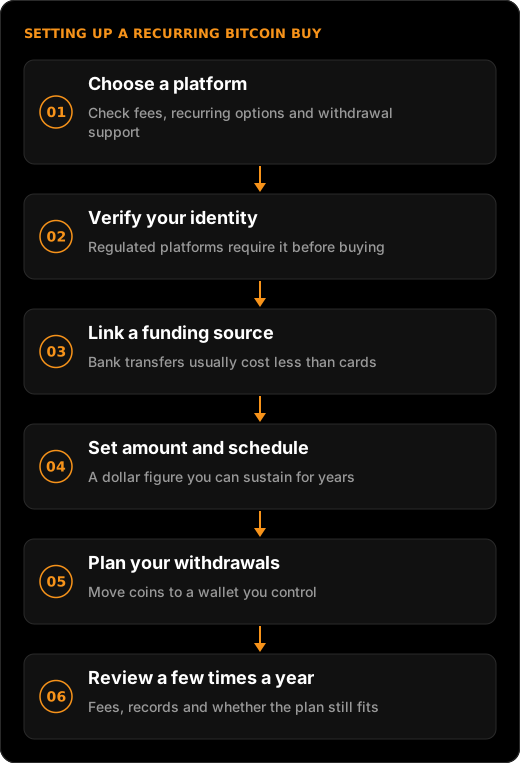
Step 3: Choose an Amount and a Schedule You Can Ignore
The best schedule is the one you never feel the need to touch. Practical anchors people use:
- Match the paycheck. Buying the day after payday means the money never sits in checking long enough to be spent elsewhere.
- Pick a number that survives bad months. If a car repair would force a cancellation, the amount is probably too high for the plan to last. Many planners put emergency savings ahead of any investing.
- Mind the fee floor. If a platform charges a flat fee per purchase, very small daily buys can lose a large share to fees. Weekly or biweekly may cost less for the same total.
Before committing, the DCA calculator shows how a given amount and frequency would have played out over past periods, so you can see the bumpy middle, not just the start and end.
Step 4: Decide Where the Coins Live
A recurring buy accumulates bitcoin on the platform by default. That is convenient, but it is also a risk worth understanding. In its March 2023 investor alert, the SEC's investor education office noted that FDIC insurance (for bank deposits) and SIPC protection (for securities held at registered broker-dealers) have no equivalent for accounts placed with crypto asset entities: "There are no such protections." The collapse of large platforms in 2022 showed what that can mean in practice.
Many stackers handle this by withdrawing to a wallet they control on a regular rhythm: monthly, quarterly, or whenever the balance crosses a set amount. Each withdrawal carries a network fee, so batching them is usually cheaper than withdrawing after every purchase. If you have not chosen a wallet yet, Hot Wallets vs. Cold Wallets explains the trade-offs, and hardware options are compared on the hardware wallets section.
Step 5: Keep Records from Day One
Every recurring purchase creates its own tax lot with its own date and cost. The IRS treats digital assets as property, and it requires you to keep records of each purchase, sale and other disposition, including the dollar value at the time. Buying alone is not a taxable event, but selling later is, and the gain is measured against what each lot cost.
Two habits make this painless. Download the platform's transaction history every year, and keep your own copy rather than relying on the platform to exist forever. The IRS also notes that brokers began reporting gross proceeds of digital asset sales on Form 1099-DA for transactions on or after January 1, 2025. The full picture is in Tax Basics for US Bitcoin Stackers.
What This Means for You
- Compare the all-in cost of one purchase. Fees and spreads repeat on every buy, so a small difference compounds over years of purchases.
- Compare funding methods. On many platforms a bank transfer is the cheapest route, and it keeps card debt out of the picture.
- Pick a withdrawal rhythm on day one. Decide how and when coins move to your own wallet before the balance grows large enough to make you nervous.
- Export your history every year. Records you hold yourself are the ones you can count on at tax time.
- Review, do not tinker. Check fees and fit a few times a year, and leave the schedule alone in between.
Set it up on a calm day, and let it work on the loud ones.