Ask ten long-time Bitcoin holders how they built their position and a surprising number will give the same boring answer: "A little every week." Not a perfectly timed bottom. Not a lucky trade. A recurring purchase they set up once and mostly stopped thinking about.
That habit has a name, dollar-cost averaging, usually shortened to DCA. In Bitcoin circles it has a nickname too: stacking sats. It is the closest thing the community has to a shared ritual.
The odd part is that the strategy is not particularly clever. Its power comes from the fact that it removes the one decision most people are worst at making: when to buy.
The Whole Strategy Fits in One Sentence
Dollar-cost averaging means investing the same dollar amount at regular intervals, regardless of what the price is doing. FINRA, the US broker regulator, describes it in exactly those terms: equal portions, regular intervals, no matter the market conditions.
If you have a 401(k) and contribute from every paycheck, you are already doing it. FINRA points to 401(k) and other employer-sponsored retirement plans as an everyday example. Bitcoin DCA is the same idea pointed at a different asset: $25 every Friday, $100 on the first of the month, or 2 percent of each paycheck.
Notice what the rule does not contain. There is no price target, no chart reading, no forecast. The amount is fixed in dollars, so the quantity of bitcoin you receive floats with the price.
The Quiet Math That Makes It Work
Because your dollar amount is fixed, a lower price automatically buys more bitcoin and a higher price buys less. Here is a hypothetical five months of $100 purchases, using round prices invented for illustration (one bitcoin is 100 million satoshis, or sats):
| Month (hypothetical) | Price per BTC | Spent | Sats bought |
|---|---|---|---|
| 1 | $50,000 | $100 | 200,000 |
| 2 | $40,000 | $100 | 250,000 |
| 3 | $25,000 | $100 | 400,000 |
| 4 | $50,000 | $100 | 200,000 |
| 5 | $80,000 | $100 | 125,000 |
| Total | $500 | 1,175,000 |
The simple average of those five prices is $49,000. But the average price actually paid is $500 divided by 0.01175 BTC, which works out to about $42,553. The crash in month three did the heavy lifting: the same $100 bought twice as many sats as it did in month one.
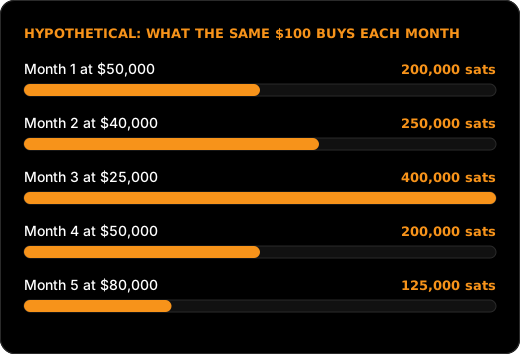
This is what FINRA means when it says DCA "sometimes results in paying a lower average price per share over time." The word "sometimes" matters. If the price only climbs, every purchase is more expensive than the last, and buying everything on day one would have been cheaper. The math rewards volatility, not any particular direction.
Analogy: Think of filling your car's tank with the same $40 every week instead of filling it to the brim. When gas is cheap, $40 buys more gallons. When it is expensive, it buys fewer. Over a year your average cost per gallon quietly tilts toward the cheap weeks, without you ever checking a single gas price.
Why Bitcoiners in Particular Swear by It
Bitcoin is a volatile asset by any measure. The SEC's investor education office has warned that investments in crypto asset securities "can be exceptionally volatile and speculative," and the BlackRock Investment Institute noted in December 2024 that bitcoin has seen selloffs of 70 to 80 percent from peak to bottom during its history. In an asset that moves like that, the timing question becomes paralyzing.
DCA answers it by refusing to answer it. Three things follow:
- It shrinks regret. Buy everything in one go and a 30 percent drop next month feels like a personal failure. Buy on a schedule and the same drop simply means your next purchases get more sats.
- It fits a paycheck. Most people do not have a pile of cash waiting to be deployed. They have income arriving every two weeks. DCA matches how money actually shows up.
- It removes the hype cycle from your hands. FINRA highlights that a fixed schedule "can remove some of the emotion from investing." In a market famous for euphoric tops and despairing bottoms, that is the feature, not a side effect.
What DCA Cannot Do
Being honest about the limits is what separates a strategy from a sales pitch.
DCA does not guarantee a profit or protect against a loss. If bitcoin falls and stays down, a schedule simply keeps buying an asset that is losing value. It also does not make a risky asset safe; it only spreads out when you take on that risk.
It has a cost when you already have the money. Vanguard's February 2023 study compared investing a lump sum immediately against splitting it into three monthly installments, using global stock market data (the MSCI World Index) from 1976 to 2022. Investing immediately came out ahead 68 percent of the time after one year, because money sitting in cash misses whatever the market does in the meantime. That research covers stocks and bonds, not bitcoin, and the full comparison lives in Lump Sum vs. DCA: What the Data Says.
Fees can eat small purchases. FINRA notes that more frequent transactions can mean higher total fees. A $10 daily buy with a flat fee attached can lose a meaningful slice of every purchase before you own a single sat.
And DCA is not the same as "buying the dip." A dip-buying plan requires judgment calls about what counts as a dip; DCA deliberately makes none. That trade-off has its own article: When to Buy the Dip (and When Not To).
Choosing Your Rhythm
The variables are simple, and none of them have a correct answer. What matters most is picking a version you can sustain for years.
- Amount: a number you can keep buying through a long drawdown without touching your emergency savings.
- Frequency: daily, weekly, every payday, or monthly. Shorter intervals smooth the average further, but check how fees scale with the number of purchases.
- Duration: open-ended, or a fixed window such as 12 months. Decide in advance so a scary headline does not decide for you.
Most exchanges and Bitcoin-only apps now offer recurring buys; the step-by-step setup is in How to Set Up Automatic Bitcoin Buys, and the platforms we track are listed on the Auto-Stack DCA tab.
What This Means for You
- Test it against history first. The DCA calculator shows how a fixed weekly or monthly amount would have behaved over past periods, including the brutal ones.
- Separate paychecks from windfalls. DCA from income is just how saving works. Spreading out a lump sum you already have is a different decision with a measurable cost.
- Size the habit, not the hope. A common test is whether an amount could keep going through a 70 percent decline without stress, because declines of that size have happened before.
- Watch the fee per purchase. A smaller number of larger buys can beat many tiny ones if each purchase carries a flat fee.
- A written rule does the work. A schedule only removes emotion if what happens when the price makes headlines was decided in advance.
The best timing strategy for most people is admitting they do not have one.