Your friend texts you: "Just bought 50k sats, moved them to cold storage, fees were low because the mempool's empty. HODL." You understand maybe four of those words.
That is normal. Bitcoin borrowed words from cryptography, economics, and internet forums, then invented a few of its own. The good news is that about 30 terms cover nearly everything you will read in your first month.
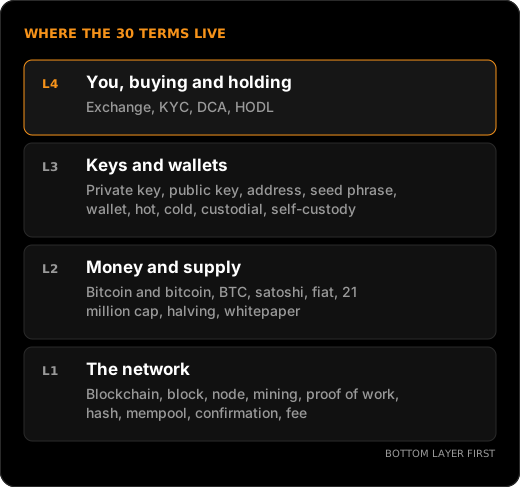
Here they are, grouped by where you will meet them, each in plain English.
Money Words: What Bitcoin Is and How It Is Counted
- Bitcoin (capital B). The network and the system as a whole: the software, the rules and the computers running them.
- bitcoin (lowercase b). The currency unit itself, the thing you own and send.
- BTC. The ticker symbol, or short trading code, for bitcoin, used the way USD stands for US dollars.
- Satoshi (sat). The smallest unit of bitcoin. One bitcoin is 100,000,000 sats, a number written directly into Bitcoin Core's code. The full story is in What Is a Satoshi?
- Fiat. Government-issued money, like dollars or euros, whose value rests on government decree rather than on a physical commodity.
- 21 million cap. The maximum number of bitcoin that will ever exist. It is enforced by every computer running the software, not by a promise.
- Halving. The scheduled event, roughly every four years, when the new bitcoin paid to miners (the computers that add new blocks) per block is cut in half. Since April 2024 it has been 3.125 BTC per block.
- Whitepaper. The nine-page document, published in 2008 under the name Satoshi Nakamoto, that first described Bitcoin.
Network Words: How It Runs Without a Boss
- Blockchain. The shared public record of every Bitcoin transaction ever made, copied across thousands of computers.
- Block. A batch of transactions added to the blockchain, on average every 10 minutes. Each block points back to the one before it, forming the chain.
- Node. A computer running Bitcoin software that keeps a copy of the blockchain and checks that everyone follows the rules.
- Mining. The process of competing to add the next block. The winner earns new bitcoin plus transaction fees.
- Proof of work. The costly computing effort miners must spend to win a block. It makes rewriting history extremely expensive.
- Hash. A digital fingerprint of data. Change even one letter of the input and the fingerprint changes completely.
- Mempool. Short for memory pool: the waiting room where valid transactions sit until a miner puts them in a block.
- Confirmation. The number of blocks that include and build on top of your transaction. More confirmations means a more settled payment. See What Happens When You Send Bitcoin.
- Transaction fee. What you pay miners to include your transaction. It depends on network demand and the transaction's size, not the amount sent.
Analogy: Picture the blockchain as a notebook that thousands of people keep identical copies of. Miners compete to write the next page, nodes check every page against the rules, and the mempool is the stack of notes waiting to be written down.
Ownership Words: Keys, Wallets and Who Holds What
This group matters most, because it is where people lose money. A table makes the differences easier to see.
| # | Term | Plain-English meaning |
|---|---|---|
| 18 | Private key | The secret number that lets you spend your bitcoin. Whoever has it controls the coins. |
| 19 | Public key | A number derived from your private key that lets others verify your signatures. Safe to share. |
| 20 | Address | Where people send you bitcoin, created from your public key. Modern ones start with "bc1". |
| 21 | Seed phrase | A list of 12 to 24 ordinary words (defined in a standard called BIP 39) that can rebuild your whole wallet. Never share it. |
| 22 | Wallet | The app or device that stores your keys and lets you send and receive. It holds keys, not coins. |
| 23 | Hot wallet | A wallet connected to the internet, like a phone app. Convenient, but more exposed. |
| 24 | Cold wallet | Keys kept offline, often on a small hardware device. Slower to use, much harder to hack. |
| 25 | Custodial | Someone else, usually an exchange, holds the keys for you. You are trusting them. |
| 26 | Self-custody | You hold your own keys. Nobody can freeze your coins, and nobody can recover them if you lose the keys. |
The trade-offs between those last few are covered in Hot Wallets vs. Cold Wallets, and our hardware wallet comparison lays out the main devices side by side.
Buying Words: The Stuff You Hear on Day One
- Exchange. A company where you trade dollars for bitcoin. Most are custodial until you withdraw.
- KYC (Know Your Customer). The identity checks regulated exchanges are required to run, like uploading a photo ID.
- DCA (dollar-cost averaging). Buying a fixed dollar amount on a regular schedule, say $25 every week, regardless of price. The DCA calculator shows how it has played out historically.
- HODL. Bitcoin slang for holding through ups and downs instead of selling. It began as a typo of "hold" in a December 2013 forum post titled "I AM HODLING" and stuck.
What This Means for You
- Learn the ownership words first. Private key, seed phrase and self-custody are the terms that protect your money. The rest can wait.
- Think in sats. Small amounts are easier to picture in sats than in tiny fractions of a bitcoin.
- Watch who holds the keys. "Custodial" or "self-custody" tells you who is responsible if something goes wrong.
- Use the vocabulary to spot nonsense. Anyone asking for your seed phrase, for any reason, is not helping you.
- Keep this page handy. Come back when a new word shows up. Most of the confusion fades within a few weeks.
Thirty words in, you can read most Bitcoin conversations. The rest is practice.