In the second quarter of 2026, Riot Platforms mined 1,587 bitcoin. By its own calculation in its 10-Q, each of those coins cost $90,631 to produce once you count the wear on its machines. Each one was worth about $71,667 when it was mined.
That gap, more than $18,000 per coin, explains most of what has happened to the public bitcoin mining industry since the 2024 halving. At Riot, mining still covers its cash costs. But the full cost of staying competitive has climbed, and many miners have found a more reliable customer for their most valuable asset, which is not their machines. It is their power.
Publicly listed miners are among the most transparent businesses in Bitcoin. They file 10-Ks and 10-Qs with the SEC, and many also publish monthly or quarterly production releases. This article reads those documents, all current as of October 7, 2026.
Why Miners Go Public
Mining is capital-hungry. A large operator needs tens of thousands of specialized machines (ASICs), sites with hundreds of megawatts of power, and the cash to replace hardware every few years as efficiency improves. Public markets offer access to equity and convertible debt at a scale private miners rarely match.
The trade-off is disclosure. Every quarter, a listed miner must explain in its filings how many bitcoin it produced, what it cost, how much it holds and what risks it faces. (How the mining itself works is covered in How Bitcoin Mining Actually Works.)
What Their Filings Tell You
Most US-listed miners report a similar set of figures. Here is where to find them:
| What you want | Where it appears | Example from a filing |
|---|---|---|
| Bitcoin produced | 10-Q/10-K and production releases | MARA: 4,669 bitcoin mined in the six months ended June 30, 2026 |
| Cost to mine one bitcoin | Management's discussion (non-GAAP) | Riot: $49,912 excluding miner depreciation, Q2 2026 |
| Bitcoin held | Digital assets note | CleanSpark: 12,205 BTC on hand at June 30, 2026, plus 1,719 BTC receivable from collateral posted (10-Q) |
| Fair value swings | Income statement | Riot: $74.6 million fair value loss on bitcoin, Q2 2026 |
| Treasury policy | Liquidity section | MARA: in 2026 expanded its strategy "to allow for sales of bitcoin held on our balance sheet" |
Two cautions. First, cost-to-mine figures are company-defined, non-GAAP measures, so Riot's and CleanSpark's are not calculated identically. Second, monthly releases are unaudited and can count holdings on a different basis. CleanSpark's August 2026 update, for example, reported 593 BTC mined, 821 BTC sold at an average price of $65,420, and total holdings of 13,703 BTC at August 31, 2026, a figure that includes 3,951 BTC posted as collateral or held as a receivable. The 10-Q separates coins on hand from collateral receivables, which is why this article uses it for the holdings figure: it is the formal record filed with the SEC. Under the fair value rule that applies to fiscal years beginning after December 15, 2024, bitcoin holdings are marked to market each quarter, which is why miners' earnings now swing with the price; the rule is explained in Bitcoin Treasury Accounting, Explained Simply.
The Halving Squeeze, in Real Numbers
The April 2024 halving cut the block subsidy from 6.25 to 3.125 BTC (the mechanics are in The Halving, Explained). Overnight, the same machines earned half as many new coins. Riot's 10-Q names the result directly: "A combination of factors, including the 2024 halving event, record high network hash rates in 2025, rising mining difficulties, and constrained access to large-scale power resources, has led to increased consolidation across the industry."
Riot's own cost table shows the squeeze from one year to the next:
| Riot, three months ended June 30 | 2025 | 2026 |
|---|---|---|
| Bitcoin mined | 1,426 | 1,587 |
| Production value of one bitcoin | $98,800 | $71,667 |
| Cost per bitcoin, excluding miner depreciation | $48,992 | $49,912 |
| Cost per bitcoin, including miner depreciation | $91,244 | $90,631 |
| Cost including depreciation, as % of value | 92.4% | 126.5% |
Cash costs barely moved. What moved was the price of bitcoin, and with half the subsidy, there is far less cushion to absorb that.
Analogy: Think of a farmer whose harvest is cut in half on a fixed schedule, while the price of the crop swings wildly. The smart farmers start asking what else their land and water rights could earn. For miners, the land and water rights are grid connections and megawatts.
From Hashrate to Data Halls
That question has a clear answer in the filings: lease the power and buildings to companies running artificial intelligence (AI) and high-performance computing (HPC) workloads, usually under long-term contracts.
Core Scientific is the starkest case. Its 10-Q for the quarter ended June 30, 2026 says that in 2024 it announced its first high-density colocation contract with CoreWeave, "marking a strategic shift," and that "The majority of the Company's revenue is derived from HDC services."
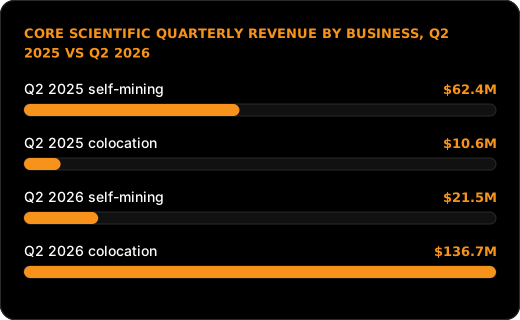
Others followed, each in its own way, according to their 2026 filings:
- IREN disclosed a five-year agreement with Microsoft announced in November 2025, representing about $9.7 billion of total contract value, plus a five-year cloud services contract with NVIDIA signed in May 2026 worth about $3.4 billion.
- Hut 8 reported that two long-term leases at its Beacon Point campus in Texas represent about $19.6 billion of aggregate base contract value.
- Riot disclosed an August 2026 lease with "a leading frontier AI lab" for an initial 191 MW at its Rockdale facility.
- MARA began a 2026 restructuring plan tied to a decision "to reallocate resources toward AI initiatives and related critical IT and HPC opportunities, as well as a significant decline in bitcoin prices."
The Bull and Bear Case for the Pivot
Supporters see the shift as smart asset management. A 10- or 15-year lease with a creditworthy tenant produces steadier cash flow than a business whose revenue halves every four years and moves with the bitcoin price.
Skeptics raise two points. Building AI data halls is capital-intensive, and filings such as IREN's describe delivery delays tied to equipment shortages. And as capacity leaves mining, these companies become less exposed to bitcoin itself. For the network, the difficulty adjustment handles departures automatically: if hashrate leaves, blocks get easier to find for whoever remains.
What This Means for You
- Read the cost table, not the headline. Riot, CleanSpark and others publish cost to mine one bitcoin. Compare it with the production value in the same filing.
- Separate mining from hosting. Many listed miners now earn more from AI leases than from bitcoin. Check revenue by segment.
- Treat monthly updates as previews. They are unaudited. The 10-Q and 10-K are the record.
- Watch treasury policy. Some miners now sell bitcoin from the balance sheet, not just new production.
- Run the numbers yourself. The ROI calculator helps you see how far price moves change a cost-to-mine comparison.
The halving cut miners' pay in half, so many found a second employer down the hall.