A bonus lands. Or a house sale closes, or an old account finally gets consolidated. You have already decided some of it is going into bitcoin. Now comes the question that keeps people staring at a buy button for weeks: all of it today, or a slice every month?
It feels like a question about courage. It is actually a question about probability, and it is one of the few in personal finance that has been studied carefully, with decades of data.
The short version: investing at once has historically come out ahead most of the time. The longer version is where it gets interesting, because the reason it wins also explains when it hurts, and bitcoin sits right at the edge of that explanation.
Two Different Questions Wearing the Same Name
"Dollar-cost averaging" gets used for two different situations, and mixing them up causes most of the confusion.
The first is buying from income: a slice of every paycheck goes into bitcoin as it arrives. There is no lump sum to compare against, because the money did not exist yet. That is just how saving works, and it is the version covered in Dollar-Cost Averaging: Why Bitcoiners Swear by It.
The second is splitting a sum you already have. The cash exists today, and you are choosing to keep part of it on the sidelines. FINRA notes that the opportunity cost argument does not apply to money coming from a workplace plan such as a 401(k), because those funds are invested as they are earned. This article is about the second situation only.
What Vanguard Found
The most cited modern study is Vanguard's February 2023 paper by Megan Finlay and Josef Zorn, which builds on a 2012 Vanguard study and academic work going back to 1979. Their base case compared investing a lump sum immediately against splitting it into three equal monthly purchases, then measured wealth one year later, on a rolling basis, using MSCI World Index returns from 1976 to 2022.
| Comparison (100% equity, global stocks, 1976 to 2022 unless noted) | Result |
|---|---|
| Lump sum beat 3-month cost averaging | 68% of rolling one-year periods |
| Cost averaging beat staying in cash | 69% of periods |
| Median wealth after one year, $100,000 start | $111,940 lump sum vs. $109,580 cost averaging |
| Worst 5% of outcomes (5th percentile) | $82,947 lump sum vs. $85,906 cost averaging |
| US stocks (Russell 3000, 1979 to 2022), 3-month vs. 6-month split | Lump sum won 66.4% vs. 73.7% of the time |
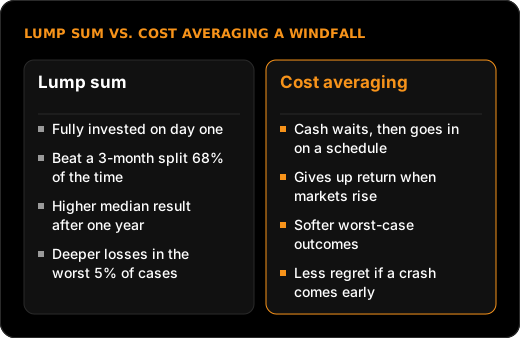
Three findings jump out. Lump sum wins most of the time, and by a modest margin at the median. Cost averaging still beats leaving the money in cash, which is the outcome Vanguard worries about most. And stretching the averaging period out makes things worse, not better: in US data, a six-month split lost to lump sum more often than a three-month split did.
Why Waiting Usually Costs You
The explanation is almost boring. From 1976 to 2022, Vanguard notes, US stocks beat cash (measured by the 3-month Treasury bill rate) 76 percent of the time. If an asset tends to rise more often than it falls, every month a dollar spends waiting is, on average, a month of missed gains. Cost averaging is a bet that the next few months will be worse than usual, placed every single time.
Analogy: Think of wading into a cold lake one step at a time instead of diving in. Most days the water is the same temperature either way, and the slow route just means less time swimming. Wading only pays off on the rare day there is a rock just under the surface.
The Catch: Some Investors Should Care About the Rocks
Vanguard does not stop at the averages. Its table shows that in the worst 5 percent of historical outcomes, cost averaging finished with more money. The paper then modeled investors with different levels of loss aversion, meaning how much more a loss hurts than an equal gain feels good. With loss aversion included, the moderately conservative and very conservative profiles preferred cost averaging, despite its lower expected return.
The authors frame the real value of cost averaging as behavioral: limiting drawdown and the regret that comes with it, which can preserve commitment to the plan. Their practical advice for loss-averse investors was to keep the averaging period short, around three months, so the cost of waiting stays small.
What Changes When the Asset Is Bitcoin
Here is where honesty matters. The Vanguard study covers stocks and bonds. We are not aware of a peer-reviewed or institutional study of comparable scope that tests lump sum against cost averaging for bitcoin, and we will not invent numbers to fill the gap.
What the published research does tell you is how to reason about it. Lump sum wins when the asset tends to rise and the averaging window is short. Cost averaging earns its keep in the bad tail, and bitcoin's bad tail is unusually fat. The BlackRock Investment Institute noted in December 2024 that bitcoin has seen selloffs of 70 to 80 percent from peak to bottom during its history. Broad stock indexes have rarely fallen that far; bitcoin has done it more than once.
That cuts both ways. Bitcoin's sharp rallies make waiting expensive in good stretches, and its crashes make the worst-case gap between the two approaches far wider than in Vanguard's stock data. The DCA calculator lets you test both approaches over real historical windows, which is the closest thing to evidence available for your specific dates. Treat what it shows as history, not a forecast.
What This Means for You
- Know which question you are answering. Buying from each paycheck is not a lump-sum decision. Splitting cash you already hold is.
- Expect lump sum to win more often. In Vanguard's 1976 to 2022 stock data, it beat a three-month split about two-thirds of the time.
- Regret has a price. In Vanguard's modeling, investors with significant loss aversion preferred cost averaging despite its lower expected return. Someone who would sell after a 50 percent drop the week after buying fits that profile.
- Longer windows cost more. Vanguard found that longer splits fell further behind, and for loss-averse investors it pointed to a relatively short period, such as three months.
- Sizing comes before timing. How large a position is relative to net worth is usually the bigger decision than how it is entered. How Much Bitcoin Should You Own? covers the frameworks.
Usually the cost of waiting is real and the rock is not there. You just never know which day you are diving.