Search "how much bitcoin should I own" and you will find confident answers everywhere. One percent. Five percent. Everything. Nothing. A number that sounds suspiciously like whatever the author already holds.
Here is the uncomfortable truth: the right amount depends on facts about you that no article can see. Your income stability, your debts, your age, your dependents, and how you actually behave when something you own falls by half.
So this article will not give you a number. It does something more useful: it lays out the frameworks people use to reach their own, and shows how each one would treat the same situation differently.
Why There Is No Magic Number
Two people with identical savings can have completely different answers. A 28-year-old with a stable job, no dependents and a full emergency fund can absorb a large loss and wait decades to recover. A 60-year-old two years from retirement, with a mortgage, cannot, even if the dollar amounts in their accounts match.
The SEC's guide to asset allocation makes the same point about any investment: the right mix depends largely on your time horizon and your ability to tolerate risk. It defines risk tolerance as "your ability and willingness to lose some or all of your original investment." Notice that the definition has two parts. Willingness is how a loss feels. Ability is whether your life still works after it.
Framework 1: Foundations First
The most common framework is not about bitcoin at all. It is about sequence. Many people build in layers, and only add a volatile asset once the layers beneath it can hold weight.
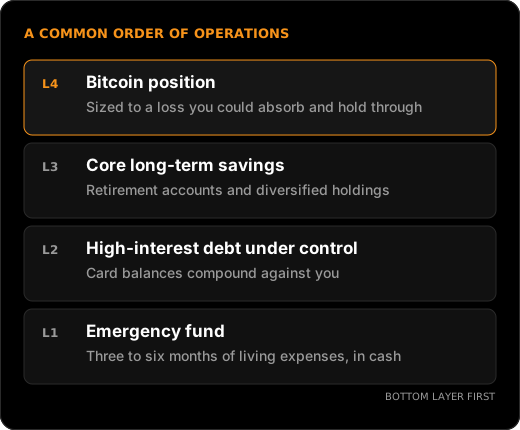
FINRA suggests an emergency fund that ideally covers about three to six months of living expenses, while noting that even a small one beats nothing. The reasoning for putting it first is mechanical: without a cash cushion, a job loss or medical bill can force you to sell whatever you own, at whatever price it happens to be that week. A position you are forced to sell at the bottom is the most expensive kind.
Framework 2: Only What You Can Lose Entirely
The SEC's investor education office has written that the only money to put at risk in any speculative investment is "money you can afford to lose entirely." Plenty of bitcoiners would argue with the word "speculative," but the framework itself is useful regardless of where you land on that debate.
The test is concrete. Imagine the amount going to zero. Does your retirement date move? Does your housing change? Do you lose sleep for a year? If the answer is yes, this framework says the amount is too large for you, whatever your conviction.
Framework 3: The Drawdown Test
A softer version of the same idea asks not "what if it goes to zero" but "what if it does what it has already done." The BlackRock Investment Institute noted in December 2024 that bitcoin has seen selloffs of 70 to 80 percent from peak to bottom during its history. So people run the numbers on a drop in that range and ask whether they could hold through it.
Here is how a 75 percent bitcoin decline would hit a hypothetical $100,000 portfolio at different bitcoin shares, assuming everything else stays flat:
| Bitcoin share (hypothetical) | Bitcoin holding | Loss if bitcoin falls 75% | Portfolio impact |
|---|---|---|---|
| 1% | $1,000 | $750 | -0.75% |
| 5% | $5,000 | $3,750 | -3.75% |
| 10% | $10,000 | $7,500 | -7.5% |
| 25% | $25,000 | $18,750 | -18.75% |
| 50% | $50,000 | $37,500 | -37.5% |
The useful question is not which row looks best on the way up. It is which row you could watch happen without selling. Many people discover their honest answer is lower than their enthusiasm suggested.
Analogy: Think of it like choosing how spicy to order your food. The menu cannot tell you the right level; only your own past experience can. The mistake is ordering based on how brave you feel when you are hungry, rather than how you will feel halfway through the plate.
Framework 4: Risk Budgeting
Professional allocators often size positions by how much risk they add, not how many dollars they take up. A volatile asset at a small weight can contribute as much to a portfolio's swings as a calm asset at a large weight.
The BlackRock Investment Institute published a well-known example of this method in "Sizing bitcoin in portfolios" on December 11, 2024. It describes its approach as risk budgeting: "sizing the allocation based on how much it would contribute to total portfolio risk." Using weekly returns from May 2012 to July 2024, it found that a 1 to 2 percent bitcoin allocation in a hypothetical 60/40 stock and bond portfolio contributed to overall risk at levels comparable to a single "Magnificent 7" stock, and that allocations beyond 2 percent "elevate portfolio risk disproportionately." Its conclusion was conditional: for institutional investors "with sufficient governance and risk tolerance," around 1 to 2 percent "could be reasonable," provided they believe in bitcoin's widespread adoption. The firm states the material is for institutional use and is not a recommendation. It appears here only to illustrate how the method works, not as a target for anyone reading this. Many individual holders reject the premise entirely and hold far more, or far less.
Framework 5: Count in Sats, Not Percentages
Some stackers skip percentages and think in units instead: a goal of a certain number of sats (one bitcoin is 100 million satoshis), built steadily from income. It turns the question from "how much of my net worth" into "how much of my monthly cash flow," which is often easier to answer honestly.
The weakness is that it can drift. A small monthly habit, left alone through a big rally, can become a much larger share of your net worth than you ever chose deliberately. That is why it pairs naturally with a periodic check on percentages, and with a plan for taking profits or holding. If income is tight, Building Your Stack on Any Income covers the cash-flow side, and the DCA calculator shows how a fixed amount would have accumulated over past periods.
What This Means for You
- The floor comes before the roof. In the foundations framework, an emergency fund keeps a bad month from forcing a sale at a bad price.
- Separate ability from willingness. Ask both how a loss would feel and whether your plans would survive it.
- Run the drawdown test with real numbers. Multiply your holding by 0.75 and ask whether you would hold through that loss.
- Expect your share to drift. Rallies grow a position on their own, so revisit the percentage on a schedule, not just when prices make news.
- Treat other people's numbers as data, not instructions. An institution's allocation reflects its goals and constraints, not yours.
The right amount is the one you can still hold on the worst day.