A lot of people quietly rule themselves out of Bitcoin with one thought: "I'll start when I have real money to put in." The price is quoted per whole coin, the headlines talk about billion-dollar treasuries, and a $20 purchase feels pointless next to all that.
The protocol disagrees. One bitcoin is 100,000,000 satoshis, and that number is hard-coded into the reference software. A $20 buy is not a rounding error. It is a precise, verifiable amount of the same asset everyone else holds, recorded on the same ledger with the same rules.
What separates a small stack that grows from one that stalls is rarely the size of the paycheck. It is the order of operations, the consistency, and a cost most beginners never look at: fees as a percentage of each buy.
The Unit Is Built for Small Amounts
Bitcoin was designed to divide. Every amount on the network is tracked internally in satoshis, or sats, the smallest unit. That makes small purchases look less silly once you change the denominator.
Here is a hypothetical example, using a round price of $100,000 per bitcoin purely for easy math:
| Weekly amount | Per year | Sats per week at a hypothetical $100,000 |
|---|---|---|
| $5 | $260 | 5,000 |
| $10 | $520 | 10,000 |
| $25 | $1,300 | 25,000 |
| $50 | $2,600 | 50,000 |
Thinking in sats turns "a tiny slice of a coin" into a whole number that goes up every week. The BTC/sats converter does this translation at the live price, and What Is a Satoshi? covers the unit itself.
Cash Buffer Before the First Sat
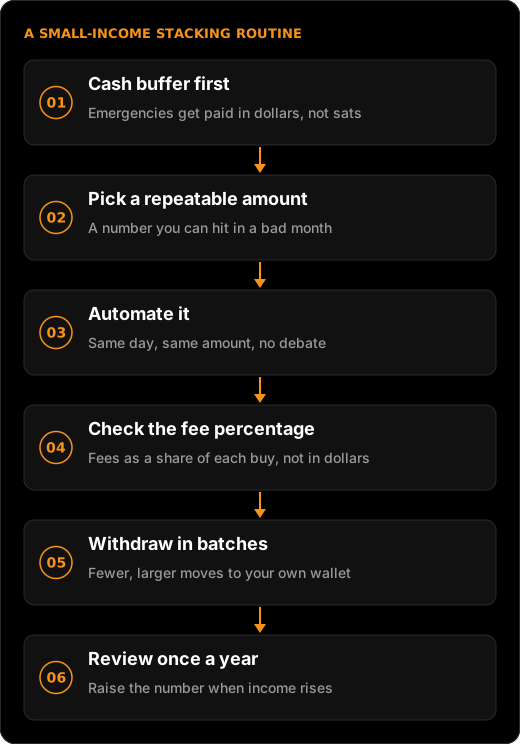
The single most common way small stackers lose money is not a bad buy. It is a forced sale. The car breaks, rent is short, and the bitcoin bought last spring gets sold in a down month to cover it.
The Consumer Financial Protection Bureau describes an emergency fund as "a cash reserve that's specifically set aside for unplanned expenses or financial emergencies," and notes that even a small amount helps. That buffer is what lets a stack sit through volatility instead of being liquidated by it. Bitcoin's price can fall by half or more, and the Bitcoin History Timeline shows it has done so repeatedly. Money that might be needed next month is not stacking money.
High-interest debt belongs in the same conversation. A credit card balance charging double-digit interest is a guaranteed cost, while bitcoin's return is anything but guaranteed. That comparison is arithmetic, not a recommendation.
Pick a Number You Can Hit in a Bad Month
Stacking works through repetition, so the right amount is the one you can repeat, not the one that feels impressive. Two common frameworks:
- Fixed amount. The same dollar figure every week or payday, for example $10. Simple, easy to automate, easy to budget around.
- Fixed percentage. A set share of each paycheck, for example 1 percent. It scales automatically when income rises and shrinks when it falls, which suits irregular or gig income.
A common rule of thumb is to set it at a level that could still be hit during the worst month of the past year. A modest number held for years tends to beat an ambitious one abandoned after a scary headline. The mechanics of regular buying are covered in Dollar-Cost Averaging, and the setup steps are in How to Set Up Automatic Bitcoin Buys. The Auto-Stack DCA options on this site list services that offer recurring purchases.
Analogy: Think of it like a gym habit. Twenty minutes three times a week, every week, builds more than a two-hour session you do twice and then quit. The schedule is the strategy.
How big the stack should eventually be relative to everything else is a separate question, explored with frameworks rather than prescriptions in How Much Bitcoin Should You Own?.
Fees Hit Small Buys Hardest
Here is the cost that quietly eats small stacks. Many platforms charge a flat minimum fee, a percentage spread, or both. A flat fee that barely registers on a large purchase can be enormous on a small one.
Hypothetical example: a flat $1.99 fee on a $1,000 purchase is about 0.2 percent. The same $1.99 on a $10 purchase is about 20 percent, meaning a fifth of the money never becomes bitcoin. Spreads (the gap between the price you pay and the market price) are harder to see because they are baked into the quote, but they apply to every buy.
Practical ways stackers handle this, in general terms:
- Compare platforms by the total cost as a percentage of your typical buy size, not the headline fee.
- If fees are flat, buying less often in larger amounts (monthly instead of weekly) can cut the percentage sharply.
- Check whether a platform's recurring-buy feature is priced differently from one-off buys.
Withdrawals and the Small-Stack Trap
Holding bitcoin on a platform means trusting that platform. Moving it to a wallet you control removes that dependency, but on-chain moves have their own cost logic.
A Bitcoin network fee is based on the size of the transaction in bytes, not on the dollar amount being moved. Sending $20 can cost the same network fee as sending $20,000. Many platforms also charge their own withdrawal fee on top. That makes frequent tiny withdrawals expensive, and it leaves your wallet full of small pieces (called outputs) that each add size, and therefore fees, when you eventually spend them. How Transactions Work explains why.
The common pattern among small stackers is to let purchases accumulate to a meaningful amount, then withdraw in one batch. Where that threshold sits depends on current network fees and how much platform risk you are comfortable carrying.
Guardrails Against the Shortcut
Small budgets attract shortcut pitches: "turn $100 into $10,000," leveraged trading, yield programs promising fixed payouts. The Federal Trade Commission is blunt about this: "Only scammers will guarantee profits or big returns." It also notes that cryptocurrency held in accounts is not insured by a government the way bank deposits are.
A slow stack has no shortcut, and anyone selling one is selling something else. The same goes for borrowing to buy: a loan payment is due every month regardless of what the price does.
What This Means for You
- The buffer protects the stack. Cash for emergencies is what keeps a stack from being sold at the worst moment.
- Repeatable beats impressive. A number sized for the worst month, not the best, is the one that tends to survive, and many stackers revisit it when income rises.
- Measure fees as a percentage. A flat fee that looks small can consume a large share of a $10 buy.
- Batch your withdrawals. Network fees depend on transaction size, not amount, so fewer and larger moves cost less.
- Ignore the shortcut pitches. A promise of certain profit is a scam signal, per the FTC, not a strategy.
Nobody's stack started big. They started on a Tuesday and kept going.