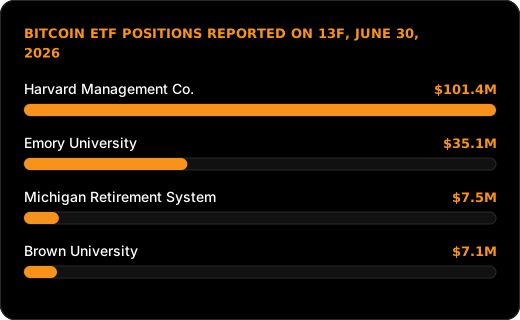
Harvard Management Company, the investment arm of Harvard's endowment, reported owning 3,044,612 shares of the iShares Bitcoin Trust as of June 30, 2026, worth about $101.4 million, according to a filing it made with the SEC on August 14, 2026.
That single line on a government form says a lot. The most conservative kind of money in America, the kind that pays professors and pensions, is now willing to hold bitcoin exposure in public view.
It also says less than the headlines suggest. The same form cannot tell you why, how big the position is relative to the whole fund, or whether the institution holds bitcoin in any other way. To read these filings well, you need to know what they are.
The Form That Puts Holdings on the Record
Large investment managers in the US file a Form 13F each quarter. It lists their long positions in US-listed stocks and exchange-traded products as of the last day of the quarter, and it is due within 45 days after the quarter ends. Anyone can read it on SEC EDGAR.
That is why almost every disclosed institutional bitcoin position you hear about is an ETF. A spot bitcoin ETF shows up on a 13F like any other listed share. Bitcoin held directly with a custodian, or through a private fund, does not. How those ETFs work is covered in Bitcoin ETFs Explained.
Analogy: A 13F is like a photo of someone's grocery cart taken at the checkout on one particular day. You can see exactly what is in the cart. You cannot see the pantry at home, what they ate last week, or why they picked that brand.
Endowments: Harvard, Emory and Brown
Several university endowments report spot bitcoin ETFs, and their positions are easy to compare because they file the same form.
Harvard Management Company held the same 3,044,612 shares at both March 31 and June 30, 2026. The reported value fell from about $117.0 million to $101.4 million between the two filings, with no change in share count. That is bitcoin's price moving, not a trade.
Emory University reported 1,354,148 shares of the Grayscale Bitcoin Mini Trust, worth about $35.1 million as of June 30, 2026. Brown University reported 212,500 shares of the iShares Bitcoin Trust, worth about $7.1 million. Both share counts were unchanged from the prior quarter.
Pensions: Michigan Holds, Wisconsin Turns Around
Public pension funds owe benefits to retirees, which makes their boards cautious by design. Two state systems show two different paths.
The State of Michigan Retirement System's 13F for June 30, 2026 reports 300,000 shares of the ARK 21Shares Bitcoin ETF (about $5.8 million) and 37,418 shares of the Grayscale Bitcoin Trust (about $1.7 million). It also lists 14,000 shares of Strategy, the bitcoin treasury company.
The State of Wisconsin Investment Board offers a sharper story. Its 13F for December 31, 2024 reported 6,060,351 shares of the iShares Bitcoin Trust, worth about $321.5 million. Its very next 13F, for March 31, 2025, listed no bitcoin ETF at all. The filing does not say why. As of June 30, 2026, Wisconsin's 13F still shows no bitcoin ETF, but it does list Strategy common stock and two Strategy convertible notes. Exposure to bitcoin can arrive through a company, not only through a fund.
The Positions Side by Side
| Institution (type) | Holding reported on 13F | As of | Reported value |
|---|---|---|---|
| Harvard Management Co. (endowment) | 3,044,612 sh. iShares Bitcoin Trust | June 30, 2026 | $101.4 million |
| Emory University (endowment) | 1,354,148 sh. Grayscale Bitcoin Mini Trust | June 30, 2026 | $35.1 million |
| Brown University (endowment) | 212,500 sh. iShares Bitcoin Trust | June 30, 2026 | $7.1 million |
| Michigan Retirement System (pension) | ARK 21Shares and Grayscale Bitcoin Trust | June 30, 2026 | $7.5 million combined |
| Wisconsin Investment Board (pension) | 6,060,351 sh. iShares Bitcoin Trust | Dec. 31, 2024 | $321.5 million, later exited |
| Mubadala (Abu Dhabi sovereign investor) | 14,721,917 sh. iShares Bitcoin Trust | June 30, 2026 | $490.1 million |
Mubadala describes itself on its own website as a sovereign investor whose shareholder is the Government of Abu Dhabi. It is not a pension or endowment, but it files the same form and shows how large institutional positions can get. Government-level adoption is a separate story, told in Nations Adopting Bitcoin.
What a 13F Cannot Tell You
Treat these numbers as facts with sharp edges.
- They are snapshots. Each figure is as of a quarter end and published up to 45 days later. The position may have changed since.
- They are not allocations. A 13F lists listed securities, not the whole fund. You cannot tell from it what share of an endowment is in bitcoin.
- They miss other routes. Direct bitcoin, private funds, futures and stakes in treasury companies held elsewhere may not appear.
- They give no reasons. Wisconsin's exit and Harvard's steady share count are both silent on motive. Any explanation not in an official statement is a guess.
What This Means for You
- Go to the source. Every position here can be checked on SEC EDGAR by searching the institution's name and opening its latest 13F.
- Separate size from conviction. Even Harvard's $101.4 million position is a single line on a long 13F. Small positions are often how cautious institutions test an asset.
- Watch the share count, not the dollar value. A falling value with unchanged shares is the market moving. A falling share count is a decision.
- Think in frameworks. Institutions size positions by policy, not excitement. How Much Bitcoin Should You Own? walks through allocation frameworks, and the ROI calculator shows what bitcoin did between any two quarter ends.
The quietest money in the world now files its bitcoin exposure in public, one quarter at a time.